
Hess’s Law of Constant Heat Summation
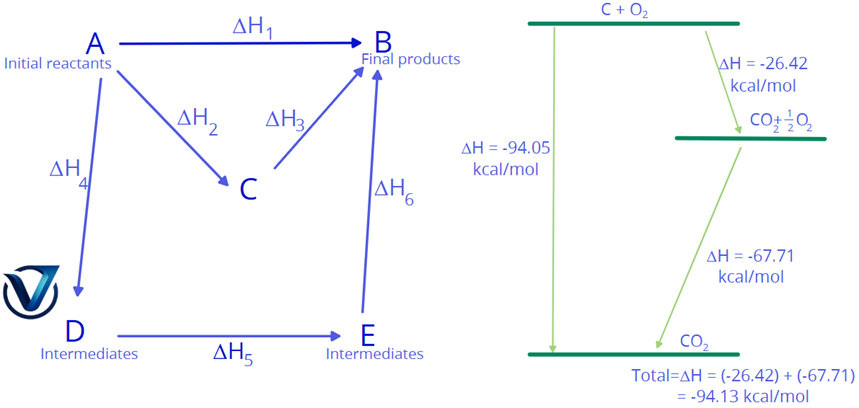
Hess’s Law states that if a chemical transformation can occur through several pathways, whether in a single step or in several stages, the total heat change remains constant regardless of the technique employed to effectuate the change. This is a direct consequence of the law of conservation of energy applied to chemical reactions.
Enthalpy is a state function, meaning its change depends only on the initial and final states, not on the path taken.
General Principle: Multiple Routes, One Destination
Consider the transformation of substance A into substance B. According to Hess’s Law, the enthalpy change (ΔH) will be identical regardless of the complexity of the reaction path.
- Route 1 (Direct): A → B (ΔH = ΔH₁)
- Route 2 (Two-Step): A → C → B (ΔH = ΔH₂ + ΔH₃)
- Route 3 (Multi-Step): A → D → E → B (ΔH = ΔH₄ + ΔH₅ + ΔH₆)
Practical Example: Formation of Carbon Dioxide (CO₂)
Carbon dioxide can be produced in one single step or through a two-stage process via carbon monoxide.
Step i: \(\text{C(s)} + \frac{1}{2}\text{O}_2(g) \rightarrow \text{CO}(g) \quad \Delta H = -110.5\ \text{kJ}\)
Step ii: \(\text{CO}(g) + \frac{1}{2}\text{O}_2(g) \rightarrow \text{CO}_2(g) \quad \Delta H = -283.0\ \text{kJ}\)
Total: \(\text{C(s)} + \text{O}_2(g) \rightarrow \text{CO}_2(g) \quad \Delta H = -110.5 + (-283.0) = -393.5\ \text{kJ}\)
The result matches the direct route, confirming Hess’s Law.
Born-Haber Cycle for Ionic Compounds
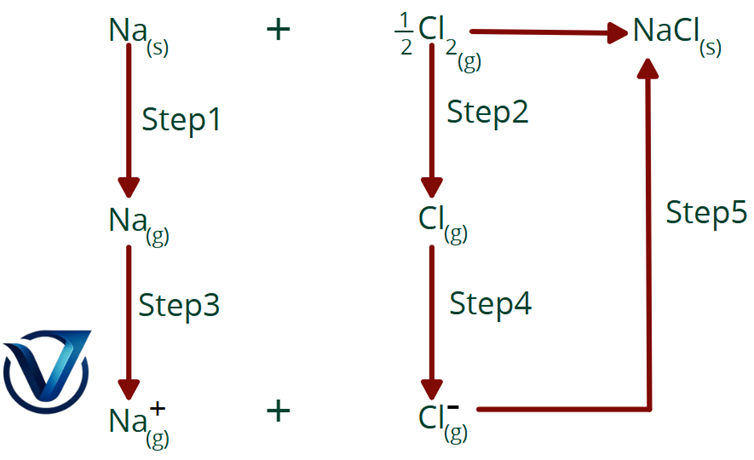
The Born-Haber cycle is a thermochemical cycle used primarily to calculate the lattice energy of ionic compounds, which is otherwise difficult to measure directly. Named after Max Born and Fritz Haber, it applies Hess’s Law to the formation of an ionic solid from its constituent elements. The cycle treats the overall enthalpy of formation as a multi-step process involving several distinct energy changes, including enthalpy of atomization, ionization energy, electron affinity, and sublimation.
Where:
- ΔHf° = standard enthalpy of formation
- ΔHat° = atomization energy
- ΔHsub° = sublimation energy
- IE = ionization energy
- EA = electron affinity
- ΔHlattice = lattice energy (negative for formation of crystal, but often defined as positive for dissociation)
Step-by-Step Calculation for NaCl
The direct synthesis of NaCl from sodium metal and chlorine gas has an enthalpy change of -411 kJ (standard enthalpy of formation).
The indirect pathway consists of five steps:
According to Hess’s Law, the sum of the enthalpy changes of the five steps must equal the direct formation enthalpy:
The lattice energy of NaCl is therefore 787 kJ/mol (positive indicates energy required to separate one mole of solid into gaseous ions).
Summary of Key Equations
Watch this lecture for a detailed explanation with examples and problem-solving.
Watch Complete Lecture in Urdu/Hindi for comprehensive understanding
Download Complete Notes Below
Proudly Powered By


Leave a Comment