
🧊 States of Matter & Real vs Ideal Gases
Matter exists in several physical forms: solid, liquid, gas, and plasma are observable in daily life. Intermediate states like liquid crystals exist, while exotic states (Bose‑Einstein condensates, neutron‑degenerate matter, quark‑gluon plasma) occur only under extreme conditions (ultra‑cold, ultra‑dense, or extremely high energy). Understanding gas behaviour is crucial because real gases deviate from the ideal gas law under many conditions.
Solid
Liquid
Gas
Plasma
📊 Comparison: Ideal Gas vs Real Gas
| Property | Ideal Gas | Real Gas |
|---|---|---|
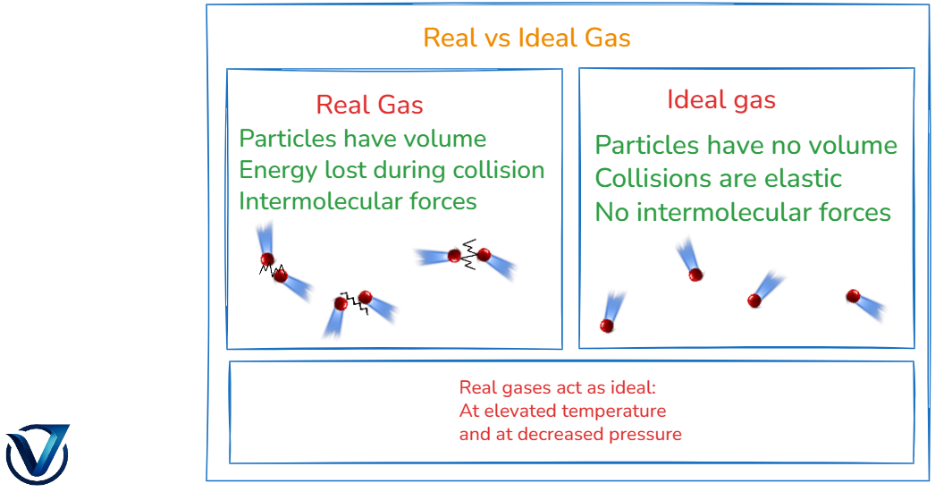
| Volume of molecules | No definite volume (point masses) | Have definite volume (molecules occupy space) |
| Collisions | Perfectly elastic | Non‑elastic (some energy loss) |
| Intermolecular forces | No attractive/repulsive forces | Significant intermolecular forces |
| Existence | Hypothetical / idealised | Exist in nature (N₂, O₂, CO₂, etc.) |
| Pressure & temperature dependence | Independent of P and T (always obeys PV=nRT) | Become ideal only at low P and high T |
| Gas laws | Obey all gas laws exactly | Deviation from gas laws at high P / low T |
🧪 Compressibility Factor (Z): Measuring Deviation
To quantify how much a real gas deviates from ideal behaviour, we use the compressibility factor Z:
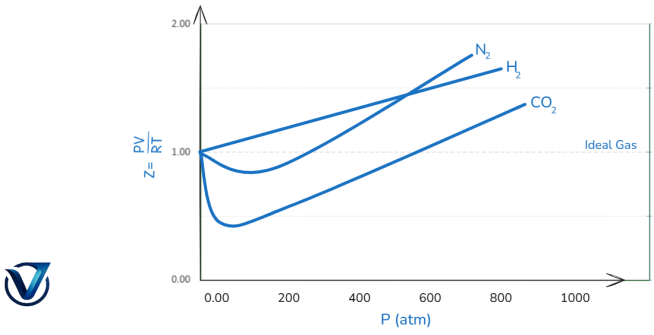
For an ideal gas, \(Z = 1\) under all conditions. For a real gas:
- \(Z < 1\) → attractive forces dominate (gas is more compressible than ideal).
- \(Z > 1\) → repulsive forces dominate (gas is less compressible).
The farther \(Z\) is from 1, the greater the non‑ideality.
🌡️ Effect of Temperature on Deviation: Boyle Temperature
As temperature increases, gas molecules have higher kinetic energy, overcoming intermolecular attractions. The deviation from ideality decreases. At a specific temperature called the Boyle temperature (TB), the gas behaves ideally over a range of pressures – Z ≈ 1. Below TB, Z dips below 1 first; above TB, Z > 1.
🔥 Boyle Temperature – Key Concept
Every gas has a characteristic Boyle temperature (TB) at which the second virial coefficient becomes zero and the gas obeys Boyle’s law (\(PV = \text{constant}\)) over a moderate pressure range. For nitrogen, TB ≈ 332 K. At this temperature, attractive and repulsive forces balance, making the gas nearly ideal.
⚙️ Interactive: Compressibility Factor Calculator
📐 Calculate Z from P, V, n, T
Enter three values (leave one empty) to compute the missing variable using the ideal gas law, or enter all four to directly calculate Z.
💡 Z=1 → ideal; Z≠1 → real gas deviation
📘 Summary: Real Gas Behaviour
- All real gases show ideal behaviour at low pressure and high temperature.
- At high pressure, repulsive forces dominate → Z > 1.
- At moderate pressures and low temperatures, attractive forces dominate → Z < 1 (gas more compressible).
- The Boyle temperature is where the gas behaves ideally over a range of pressures.
- Gases that liquefy easily (e.g., CO₂, NH₃) show larger deviations.
📘 For a deeper understanding of compressibility factor, Boyle temperature, and gas behaviour, watch this comprehensive lecture.
Download Complete Notes Below
Proudly Powered By


Leave a Comment