Zeroth Law of Thermodynamics
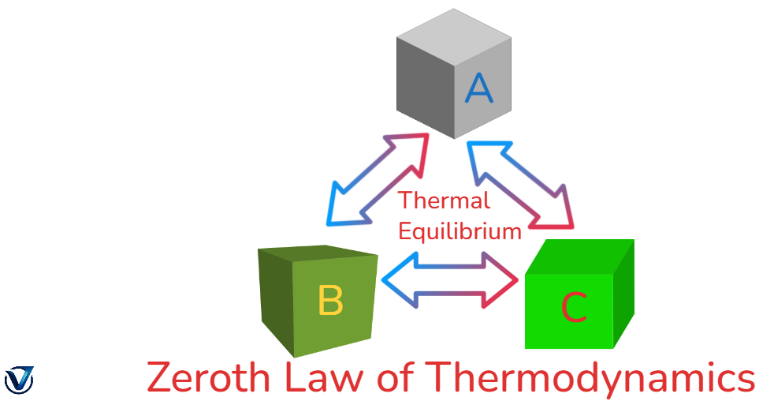
The Zeroth Law of Thermodynamics states that if two bodies are in thermal equilibrium with a third body, then they are also in thermal equilibrium with each other. In simple terms: If A = B and C = B, then A = C (where “=” means “is in thermal equilibrium with”).
This law might seem obvious, but it is fundamental because it allows us to define temperature and build thermometers. It was named the “Zeroth” law because it was recognised after the first, second, and third laws had already been named — yet it is logically prior to them, hence “zeroth”.
Understanding Thermal Equilibrium
Thermal equilibrium occurs when two objects in physical contact no longer exchange net heat energy. At this point, they have the same temperature. The Zeroth Law establishes that temperature is a transitive property, allowing us to compare temperatures without direct contact.
Without the Zeroth Law, we could not reliably use a thermometer: the thermometer (body B) reaches equilibrium with the object (body A), and then we can infer that any other object (body C) that also equilibrates with the same thermometer has the same temperature as A.
Why “Zeroth”?
The first, second, and third laws were formulated earlier. Later, scientists realised that a more fundamental law—the one that defines temperature—was needed as a basis for the others. Since it logically precedes the first law, it was named the “zeroth” law. It was proposed by R.H. Fowler in the 1930s.
Applications of the Zeroth Law
The most common application is the thermometer. All thermometers work by allowing the measuring substance (mercury, alcohol, gas, or a thermoelectric material) to reach thermal equilibrium with the object whose temperature is being measured. The change in a physical property (length, volume, resistance, pressure) is then calibrated to a temperature scale.
Examples of Thermometers
- Mercury‑in‑glass thermometer: Mercury expands uniformly with temperature; the length of the mercury column indicates temperature.
- Constant‑volume gas thermometer: Measures pressure changes of a gas at fixed volume; very accurate for calibration.
- Constant‑pressure gas thermometer: Measures volume changes of a gas at fixed pressure.
- Electrical resistance thermometer (RTD): Electrical resistance of a metal (e.g., platinum) varies with temperature.
- Thermocouple: Measures voltage generated by two dissimilar metals at a junction.
Everyday Examples
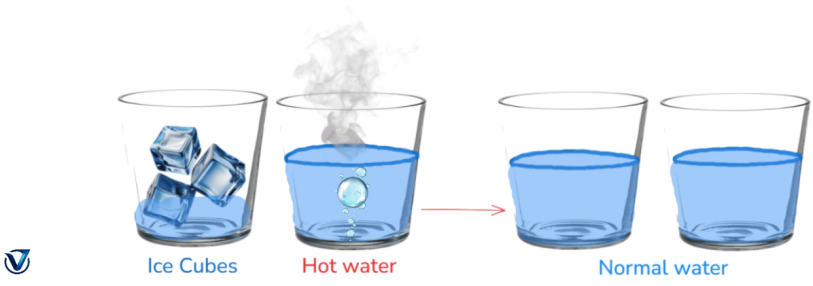
- Hot and cold water glasses: A glass of hot water left on a table will cool to room temperature; a glass of cold water will warm to room temperature. Both eventually reach thermal equilibrium with the room (the “third body”).
- Cooking thermometer: Inserting a meat thermometer into a roast allows the thermometer to equilibrate; the reading tells you the internal temperature.
- Room thermostat: The thermostat sensor reaches equilibrium with the room air, then switches the heating/cooling system to maintain a set temperature.
Relation to Other Laws of Thermodynamics
- First Law: Conservation of energy – work and heat are interchangeable. The Zeroth Law enables the temperature scale needed to define heat transfer.
- Second Law: Defines the direction of heat flow (from hot to cold). The Zeroth Law provides the concept of “same temperature” so that the Second Law can state that heat flows from higher to lower temperature.
- Third Law: Absolute zero is unattainable, and entropy of a perfect crystal is zero at 0 K. The Zeroth Law’s concept of equilibrium is essential for defining absolute temperature scales.
Importance in Science and Engineering
The Zeroth Law is the logical basis for temperature measurement. Without it, we could not calibrate thermometers or compare temperatures across different instruments. It allows the existence of a temperature scale (Celsius, Fahrenheit, Kelvin). In practice, it underpins:
- Industrial temperature control (furnaces, reactors, HVAC).
- Medical thermometers (digital, infrared, mercury).
- Weather monitoring and climate science.
- Food safety (thermometers for cooking).
Key Takeaways
- Zeroth Law: If A is in thermal equilibrium with B, and C is in thermal equilibrium with B, then A and C are in equilibrium.
- It defines temperature as a transitive property and enables temperature measurement.
- All thermometers rely on the Zeroth Law to reach equilibrium with the measured object.
- The law is called “zeroth” because it was realised after the first three laws but is logically prior.