Third Law of Thermodynamics | Absolute Entropy, Nernst Theorem & Applications
Third Law of Thermodynamics
Absolute Zero · Zero Entropy of Pure Crystals · Absolute Entropy · Nernst Theorem
Interactive Lattice Simulation
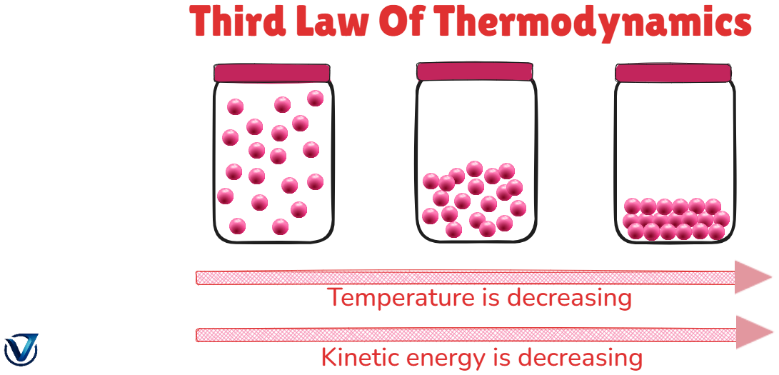
As absolute temperature approaches zero, entropy of a pure crystalline substance approaches a precise minimum. Absolute zero cannot be reached in a finite number of steps.
EntropyS = kB · ln(Ω)
LimitlimT→0 S = 0
Microstates (Ω)1
Temperature (T)300 K
300.0 K
Entropy (S)100%
2.45 J/K
System State
Thermal Agitation
High kinetic motion. Multiple reachable microstates (Ω ≫ 1). High disorder.
Lattice Structure
Pure Perfect Crystal
Thermal Energy / Temperature300 K
Lattice Atom
Ideal Lattice Site
Thermal Motion
Defect / Disorder
The third law of thermodynamics states that as the temperature of a system approaches absolute zero (0 K), the entropy of the system approaches a constant minimum value. For a perfectly crystalline substance, the entropy at absolute zero is exactly zero. This law provides an absolute reference point for entropy measurements, allowing the calculation of absolute entropies of substances.
Fig. 1: As temperature approaches absolute zero, the entropy of a perfect crystalline solid tends to zero.
Detailed Statement of the Third Law
The third law can be expressed in several equivalent ways:
Nernst heat theorem (1906): As the temperature of a system approaches absolute zero, the change in entropy in any isothermal process approaches zero.
Planck’s statement (1911): The entropy of a perfect crystal at absolute zero is zero.
Simon’s statement (1931): The entropy change in any process tends to zero as the temperature approaches absolute zero, and the entropy of a system at absolute zero is a universal constant that can be taken as zero.
This law is a consequence of quantum mechanics: at absolute zero, a perfect crystal exists in its unique lowest‑energy quantum state (ground state), which has a degeneracy of one, giving zero entropy.
Calculation of Absolute Entropy
The third law allows us to compute the absolute entropy of a substance at any temperature \(T\) by integrating heat capacity data from 0 K to \(T\). For a pure substance that undergoes no phase transitions, the entropy at temperature \(T\) is:
\[
S(T) = \int_{0}^{T} \frac{C_p(T)}{T} \, dT
\]
If phase transitions (melting, vaporization) occur, their entropy contributions (\(\Delta S_{\text{fus}} = \Delta H_{\text{fus}}/T_{\text{fus}}\), etc.) are added:
This method yields absolute entropies (also called third‑law entropies), which are tabulated for many substances at 298 K.
Implementation and Applications
Determining purity of crystalline substances: If a crystal is not perfect (has defects, impurities, or amorphous regions), its entropy at 0 K will be greater than zero. Thus, deviations from zero entropy indicate non‑ideality.
Calculation of absolute entropies: Using heat capacity measurements down to very low temperatures (e.g., below 10 K) and integrating \(C_p/T\), experimental absolute entropies are obtained.
Chemical affinity and Nernst theorem: The third law implies that near absolute zero, the change in Gibbs free energy (\(\Delta G\)) and the change in enthalpy (\(\Delta H\)) for a reaction become equal. This is the Nernst heat theorem, which helped establish the third law.
Low‑temperature physics: Understanding properties of superconductors, superfluids, and Bose‑Einstein condensates relies on third‑law principles.
Phase and chemical equilibrium: Third‑law entropies are essential for calculating equilibrium constants using thermodynamic tables.
Inconsistency with Other Laws? (Unattainability of Absolute Zero)
The third law is consistent with the first and second laws. However, a corollary of the third law is the unattainability principle: it is impossible to cool any system to absolute zero in a finite number of steps. This complements the second law, which forbids spontaneous heat transfer from cold to hot. To reach absolute zero, a system would need to extract heat from its surroundings — but as temperature drops, the heat capacity becomes extremely small, making further cooling increasingly difficult. Thus, while the third law defines zero entropy as a reference, absolute zero remains a theoretical limit, not an achievable temperature.
Significance of the Third Law
Provides an absolute scale for entropy (unlike enthalpy, which requires a reference state).
Allows prediction of reaction spontaneity at any temperature using absolute entropies.
Essential for materials science (e.g., understanding glassy states and residual entropy).
Enables calculation of equilibrium constants from tabulated thermodynamic data via \(\Delta G^\circ = \Delta H^\circ – T\Delta S^\circ\).
Interactive: Estimate Absolute Entropy at 298 K
For a simple substance with constant heat capacity (approximation), enter the heat capacity \(C_p\) (J·mol⁻¹·K⁻¹) and any phase transition temperatures and enthalpies (optional). This calculator gives a rough estimate of \(S_{298}\) using integration.
Absolute Entropy Estimator (simplified)
Enter values (leave fields empty if no phase transition). Assumes solid from 0 K to Tm, liquid to Tb, gas beyond. For demonstration only.
Note: Real calculations require integration of \(C_p/T\) with precise low‑T data.
Examples of Residual Entropy
Some substances do not achieve perfect order at 0 K, leading to residual entropy. For example, carbon monoxide (CO) molecules can arrange randomly with either C–O or O–C orientations in the crystal, giving a non‑zero entropy at absolute zero. The third law helps quantify such disorder.
Key Takeaways
The third law establishes that the entropy of a perfect crystal is zero at 0 K.
It enables the calculation of absolute entropies from heat capacity data.
Absolute zero is unattainable, consistent with the third law’s corollary.
Applications include determining crystal purity, computing thermodynamic quantities, and understanding low‑temperature behaviour.
📘 For a detailed video lecture on the Third Law of Thermodynamics, absolute entropy calculations, and Nernst theorem, refer to standard thermodynamics resources or your course materials.
/* Third Law Lattice Simulation – WordPress-safe (no && or ||) */
(function () {
if (window.__tlSimRunning) return;
window.__tlSimRunning = true;var GRID_ROWS = 6;
var GRID_COLS = 8;
var targetTemperature = 300;
var currentTemperature = 300;
var hasDefect = false;
var animationFrameId = null;
var latticeSites = [];
var width = 0;
var height = 0;
var canvas = null;
var ctx = null;function get(id) { return document.getElementById(id); }function resizeCanvas() {
if (!canvas) return;
var parent = canvas.parentNode;
if (!parent) return;
var rect = parent.getBoundingClientRect();
canvas.width = rect.width;
canvas.height = rect.height;
width = canvas.width;
height = canvas.height;
initLattice();
}function LatticeAtom(row, col, originX, originY) {
this.row = row;
this.col = col;
this.originX = originX;
this.originY = originY;
this.x = originX;
this.y = originY;
this.phase = Math.random() * Math.PI * 2;
this.isDefective = false;
this.defectOffsetAngle = Math.random() * Math.PI * 2;
}LatticeAtom.prototype.update = function (temp) {
if (temp < 0.01) {
if (!this.isDefective) {
this.x += (this.originX – this.x) * 0.2;
this.y += (this.originY – this.y) * 0.2;
} else {
var defX = this.originX + 14 * Math.cos(this.defectOffsetAngle);
var defY = this.originY + 14 * Math.sin(this.defectOffsetAngle);
this.x += (defX – this.x) * 0.2;
this.y += (defY – this.y) * 0.2;
}
return;
}
var thermalAmplitude = Math.sqrt(temp) * 0.85;
this.phase += 0.05 + (temp / 300) * 0.1;
var noiseX = (Math.random() – 0.5) * thermalAmplitude * 0.4;
var noiseY = (Math.random() – 0.5) * thermalAmplitude * 0.4;
var targetX = this.originX + Math.sin(this.phase + this.row) * thermalAmplitude + noiseX;
var targetY = this.originY + Math.cos(this.phase + this.col) * thermalAmplitude + noiseY;
if (this.isDefective) {
targetX += 14 * Math.cos(this.defectOffsetAngle);
targetY += 14 * Math.sin(this.defectOffsetAngle);
}
this.x += (targetX – this.x) * 0.3;
this.y += (targetY – this.y) * 0.3;
};LatticeAtom.prototype.draw = function () {
ctx.beginPath();
ctx.arc(this.originX, this.originY, 6, 0, Math.PI * 2);
if (this.isDefective) {
ctx.strokeStyle = 'rgba(244, 63, 94, 0.3)';
} else {
ctx.strokeStyle = 'rgba(56, 189, 248, 0.2)';
}
ctx.lineWidth = 1;
ctx.stroke();ctx.beginPath();
ctx.moveTo(this.originX, this.originY);
ctx.lineTo(this.x, this.y);
ctx.strokeStyle = 'rgba(255, 255, 255, 0.15)';
ctx.lineWidth = 1;
ctx.stroke();ctx.beginPath();
ctx.arc(this.x, this.y, 8, 0, Math.PI * 2);
if (this.isDefective) {
ctx.fillStyle = '#f43f5e';
ctx.shadowColor = '#f43f5e';
} else {
var tempRatio = currentTemperature / 300;
if (tempRatio < 0.1) {
ctx.fillStyle = '#38bdf8';
ctx.shadowColor = '#38bdf8';
} else {
if (tempRatio < 0.6) {
ctx.fillStyle = '#818cf8';
ctx.shadowColor = '#818cf8';
} else {
ctx.fillStyle = '#f59e0b';
ctx.shadowColor = '#f59e0b';
}
}
}
ctx.shadowBlur = Math.min(15, 2 + (currentTemperature / 300) * 10);
ctx.fill();
ctx.shadowBlur = 0;
};function initLattice() {
latticeSites = [];
var paddingX = width * 0.15;
var paddingY = height * 0.18;
var spacingX = (width – paddingX * 2) / (GRID_COLS – 1);
var spacingY = (height – paddingY * 2) / (GRID_ROWS – 1);
for (var r = 0; r < GRID_ROWS; r++) {
for (var c = 0; c < GRID_COLS; c++) {
var x = paddingX + c * spacingX;
var y = paddingY + r * spacingY;
var atom = new LatticeAtom(r, c, x, y);
if (hasDefect) {
if (r === Math.floor(GRID_ROWS / 2)) {
if (c === Math.floor(GRID_COLS / 2)) {
atom.isDefective = true;
}
}
}
latticeSites.push(atom);
}
}
}function drawLatticeBonds() {
ctx.lineWidth = 1.5;
for (var i = 0; i < latticeSites.length; i++) {
var a1 = latticeSites[i];
for (var j = i + 1; j < latticeSites.length; j++) {
var a2 = latticeSites[j];
var isNeighbor = false;
if (Math.abs(a1.row – a2.row) === 1) {
if (a1.col === a2.col) isNeighbor = true;
}
if (Math.abs(a1.col – a2.col) === 1) {
if (a1.row === a2.row) isNeighbor = true;
}
if (isNeighbor) {
var dist = Math.hypot(a1.x – a2.x, a1.y – a2.y);
var maxDist = 90;
var alpha = Math.max(0.05, 0.4 – (dist / maxDist) * 0.2);
ctx.beginPath();
ctx.moveTo(a1.x, a1.y);
ctx.lineTo(a2.x, a2.y);
if (a1.isDefective) {
ctx.strokeStyle = 'rgba(244, 63, 94, ' + (alpha * 1.5) + ')';
} else {
if (a2.isDefective) {
ctx.strokeStyle = 'rgba(244, 63, 94, ' + (alpha * 1.5) + ')';
} else {
ctx.strokeStyle = 'rgba(56, 189, 248, ' + alpha + ')';
}
}
ctx.stroke();
}
}
}
}function updateMetrics() {
currentTemperature += (targetTemperature – currentTemperature) * 0.1;
if (Math.abs(currentTemperature – targetTemperature) < 0.001) {
currentTemperature = targetTemperature;
}var microstates = 1;
var entropyValue = 0;
if (hasDefect) {
microstates = 8;
var residualEntropy = 0.45;
var thermalEntropy = (currentTemperature / 300) * 2.0;
entropyValue = residualEntropy + thermalEntropy;
} else {
if (currentTemperature < 0.01) {
microstates = 1;
} else {
microstates = Math.round(1 + Math.pow(currentTemperature / 10, 1.8));
}
entropyValue = (currentTemperature / 300) * 2.45;
}
var entropyPercentage = Math.min(100, (entropyValue / 2.45) * 100);var tK = get('tlTempK');
var tDisp = get('tlTempDisp');
var sVal = get('tlSliderVal');
var eDisp = get('tlEntDisp');
var ePct = get('tlEntPct');
var eBar = get('tlEntBar');
var micro = get('tlMicro');
var badge = get('tlBadge');
var desc = get('tlStateDesc');
var latType = get('tlLatticeType');if (tK) tK.innerText = currentTemperature.toFixed(currentTemperature < 1 ? 3 : 1) + ' K';
if (tDisp) tDisp.innerText = currentTemperature.toFixed(1) + ' K';
if (sVal) sVal.innerText = currentTemperature.toFixed(1) + ' K';
if (eDisp) eDisp.innerText = entropyValue.toFixed(2) + ' J/K';
if (ePct) ePct.innerText = Math.round(entropyPercentage) + '%';
if (eBar) eBar.style.width = Math.max(2, entropyPercentage) + '%';
if (micro) micro.innerText = microstates.toLocaleString();if (currentTemperature 0)’;
badge.style.background = ‘rgba(245, 158, 11, 0.2)’;
badge.style.color = ‘var(–amber)’;
}
if (desc) desc.innerText = ‘Imperfect crystal retains residual entropy even at 0 K due to frozen structural degeneracy.’;
} else {
if (badge) {
badge.innerText = ‘Absolute Zero Ground State’;
badge.style.background = ‘rgba(52, 211, 153, 0.2)’;
badge.style.color = ‘var(–emerald)’;
}
if (desc) desc.innerText = ‘Third Law Verified: Perfect ground state achieved. Molecular motion ceases; S = 0 J/K.’;
}
} else {
if (currentTemperature < 50) {
if (badge) {
badge.innerText = 'Quantum Ground Region';
badge.style.background = 'rgba(56, 189, 248, 0.2)';
badge.style.color = 'var(–cyan)';
}
if (desc) desc.innerText = 'Thermal motion severely suppressed. Phonons freezing out into single quantum state.';
} else {
if (badge) {
badge.innerText = 'Thermal Agitation';
badge.style.background = 'rgba(244, 63, 94, 0.2)';
badge.style.color = 'var(–rose)';
}
if (desc) desc.innerText = 'High kinetic motion. Multiple reachable microstates (Ω ≫ 1). High disorder.';
}
}if (hasDefect) {
if (latType) {
latType.innerText = 'Crystal with Structural Defect';
latType.style.color = 'var(–rose)';
}
} else {
if (latType) {
latType.innerText = 'Pure Perfect Crystal';
latType.style.color = 'var(–emerald)';
}
}
}function render() {
if (!ctx) return;
ctx.clearRect(0, 0, width, height);
drawLatticeBonds();
for (var i = 0; i < latticeSites.length; i++) {
latticeSites[i].update(currentTemperature);
latticeSites[i].draw();
}
updateMetrics();
animationFrameId = requestAnimationFrame(render);
}function attachControls() {
var slider = get('tlTempSlider');
var snap = get('tlSnapZero');
var toggle = get('tlToggleDefect');
var reset = get('tlReset');if (slider) {
slider.addEventListener('input', function (e) {
targetTemperature = parseFloat(e.target.value);
});
}
if (snap) {
snap.addEventListener('click', function () {
targetTemperature = 0.001;
if (slider) slider.value = 0.001;
});
}
if (reset) {
reset.addEventListener('click', function () {
targetTemperature = 300;
if (slider) slider.value = 300;
});
}
if (toggle) {
toggle.addEventListener('click', function () {
hasDefect = !hasDefect;
if (hasDefect) {
toggle.classList.add('active');
toggle.innerText = 'Remove Crystal Defect';
} else {
toggle.classList.remove('active');
toggle.innerText = 'Toggle Crystal Defect';
}
initLattice();
});
}
}function start() {
canvas = get('tlLatticeCanvas');
if (!canvas) {
setTimeout(start, 250);
return;
}
ctx = canvas.getContext('2d');
if (!ctx) {
setTimeout(start, 250);
return;
}
resizeCanvas();
if (width < 40) {
setTimeout(start, 250);
return;
}
attachControls();
window.addEventListener('resize', function () {
resizeCanvas();
});
render();
}if (document.readyState === 'complete') {
setTimeout(start, 100);
} else {
if (document.readyState === 'interactive') {
setTimeout(start, 100);
} else {
document.addEventListener('DOMContentLoaded', function () { setTimeout(start, 150); });
window.addEventListener('load', function () { setTimeout(start, 200); });
}
}
setTimeout(start, 800);
setTimeout(start, 1800);/* Absolute Entropy Calculator */
var calcBtn = document.getElementById('calcEntropyBtn');
if (calcBtn) {
calcBtn.addEventListener('click', function () {
var cpSolid = parseFloat(document.getElementById('cpSolid').value);
var tm = parseFloat(document.getElementById('tm').value);
var dhFus = parseFloat(document.getElementById('dhFus').value);
var cpLiquid = parseFloat(document.getElementById('cpLiquid').value);
var tb = parseFloat(document.getElementById('tb').value);
var dhVap = parseFloat(document.getElementById('dhVap').value);
var targetT = 298;
var S = 0;
var valid = false;if (!isNaN(cpSolid)) {
var upperSolid = targetT;
if (!isNaN(tm)) {
if (tm 0) {
S = cpSolid * Math.log(upperSolid);
valid = true;
}
}
if (!isNaN(tm)) {
if (!isNaN(dhFus)) {
if (tm < targetT) {
S += (dhFus * 1000) / tm;
valid = true;
}
}
}
if (!isNaN(cpLiquid)) {
var startLiq = 0;
if (!isNaN(tm)) {
if (tm < targetT) startLiq = tm;
}
var endLiq = targetT;
if (!isNaN(tb)) {
if (tb startLiq) {
if (startLiq > 0) {
S += cpLiquid * Math.log(endLiq / startLiq);
valid = true;
}
}
}
if (!isNaN(tb)) {
if (!isNaN(dhVap)) {
if (tb < targetT) {
S += (dhVap * 1000) / tb;
valid = true;
}
}
}
if (!isNaN(cpLiquid)) {
if (!isNaN(tb)) {
if (tb < targetT) {
S += cpLiquid * Math.log(targetT / tb);
valid = true;
}
}
}var res = document.getElementById('entropyResult');
if (!valid) {
if (res) res.innerHTML = 'Please enter at least a solid Cp value to estimate S(298 K). For a simple solid with no transitions, S(298) ≈ Cp × ln(298).';
} else {
if (res) res.innerHTML = 'Estimated absolute entropy at 298 K: ‘ + S.toFixed(1) + ‘ J·mol⁻¹·K⁻¹. (This is a simplified approximation. Real values require integration of Cp/T with low‑temperature data.)’;
}
});
}
})();