
Measurement of Electrolytic Conductance
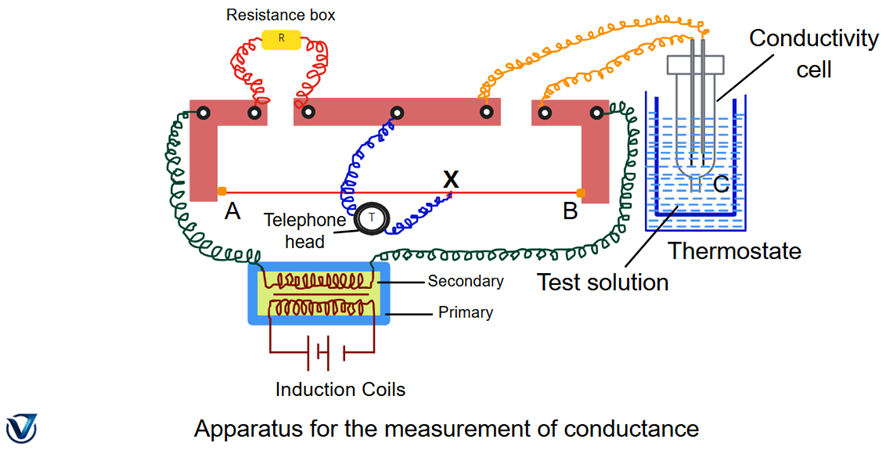
Conductance tells us how easily electricity passes through a solution. It is the reciprocal of resistance: if resistance is high, conductance is low, and vice versa. To measure conductance, a Wheatstone bridge setup is used. The solution is placed in a conductance cell fitted with platinum electrodes coated with platinum black – this prevents polarization and ensures accurate readings.
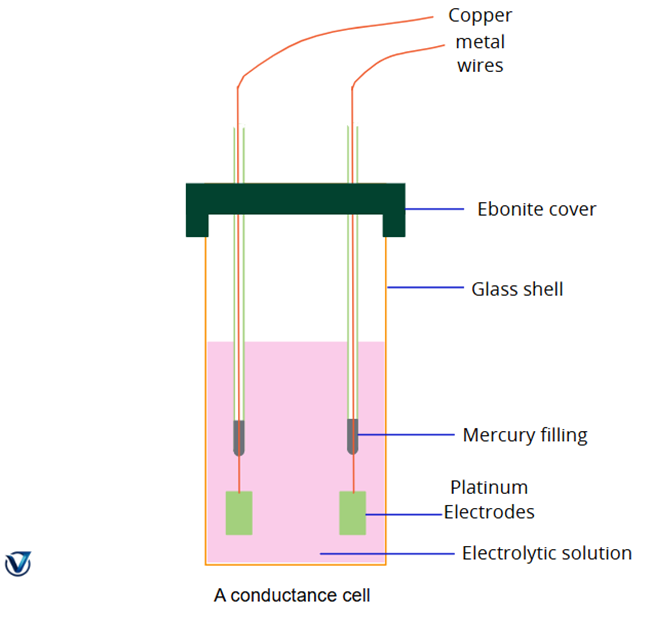
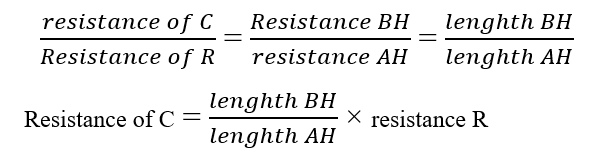
The electrodes are connected to the circuit through mercury contacts and copper wires. A headphone replaces the galvanometer to detect the balance point (minimum sound indicates balance). The resistance box (R), sliding contact (H), manganin wire (AB), and induction coil (I) complete the circuit. Once resistance is measured, conductance (G) is calculated as:
Specific Conductance (κ)
Specific conductance (also called conductivity) is the conductance of 1 cm³ of solution. It depends on the concentration and nature of the electrolyte. It is calculated using the measured resistance and the cell constant (x = l/A, where l is distance between electrodes and A is their area).
where x is the cell constant (in cm⁻¹).
Equivalent Conductance (Λ)
Equivalent conductance is the conductance of all the ions produced by one gram‑equivalent of solute in a given solution. It is calculated from specific conductance:
Here, N is the gram‑equivalent concentration (normality).
Molar Conductance (Λₘ)
Molar conductance is the conductance of all the ions produced by one mole of solute. It is given by:
where M is the molar concentration (moles per litre).
Cell Constant (x = l / A)
The cell constant depends on the distance between the electrodes (l) and their effective area (A). Because these dimensions are difficult to measure directly, the cell constant is determined indirectly using a standard KCl solution whose specific conductance is known accurately. Once the cell constant is known, the conductance of any unknown solution can be easily found.
After calibration, for an unknown solution: κ(unknown) = x / R(unknown).
Understanding Conductance
- High conductance – ions move freely (e.g., strong electrolytes in dilute solutions).
- Low conductance – ion movement is restricted (e.g., weak electrolytes or concentrated solutions with ion pairing).
In the lab, the Wheatstone bridge acts like a balance scale for electricity. When the headphone sound fades, the bridge is balanced – that is the point where resistance can be measured accurately. Platinum black coating on electrodes prevents polarisation (gas bubble formation) and ensures reproducible readings.
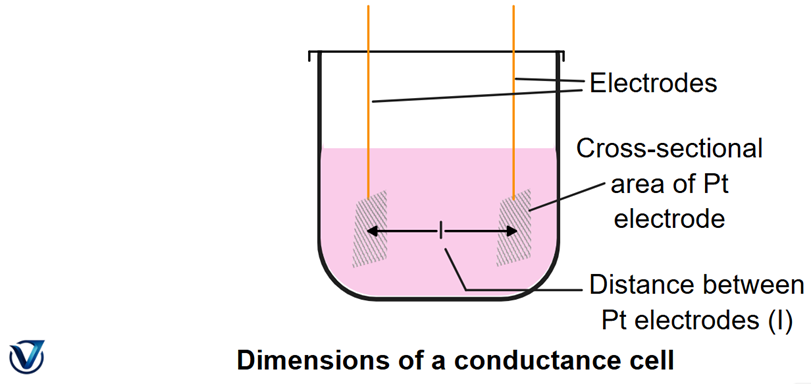
The cell constant is like a fingerprint of the conductance cell – it depends only on the geometry of the electrodes. Once determined, it remains constant for that cell. This is why scientists use a known KCl solution to calibrate the cell before measuring unknown samples.
Key Takeaways
- Conductance = 1 / Resistance
- Wheatstone bridge with headphone detection gives precise resistance values.
- Specific conductance (κ) = (1/R) × cell constant
- Equivalent conductance (Λ) = (κ × 1000) / normality
- Molar conductance (Λₘ) = (κ × 1000) / molarity
- Cell constant is determined using a standard KCl solution.

