Second Law of Thermodynamics
In an isolated system, the second law of thermodynamics states that entropy perpetually increases. Any isolated system naturally evolves towards thermal equilibrium — the condition of maximum entropy. The entropy of the universe is perpetually expanding and never diminishes.
where \(\Delta S_{\text{universe}}\) is the change in entropy of the universe. For any spontaneous process, the total entropy change is positive.
Kelvin‑Planck Statement of the Second Law
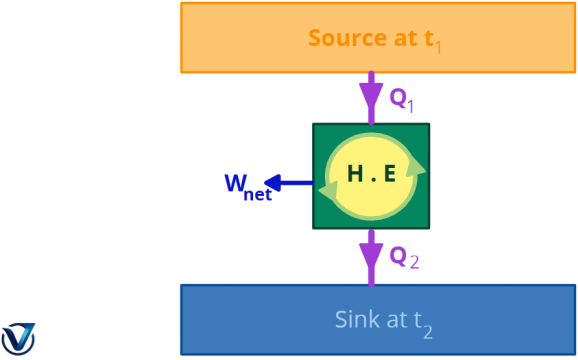
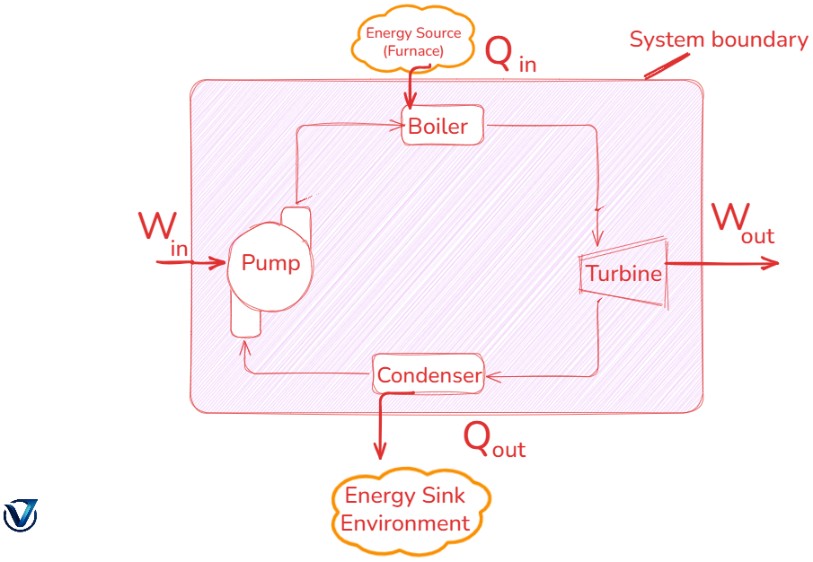
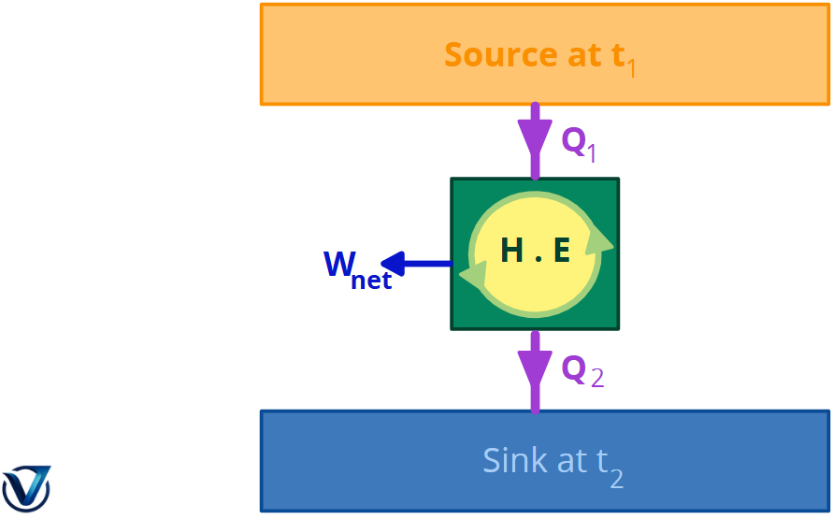
A heat engine cannot generate work in a complete cycle if it exchanges heat only with bodies at a single constant temperature. In other words, no engine can convert all the heat from a source into work without rejecting some waste heat. A sink (cold reservoir) is essential for continuous work extraction.
Clausius Statement of the Second Law
It is impossible to build a device that transfers heat from a colder body to a warmer body without any external energy input. In other words, a refrigerator or heat pump cannot operate unless a compressor is powered by an external source. This statement applies to refrigerators and heat pumps.

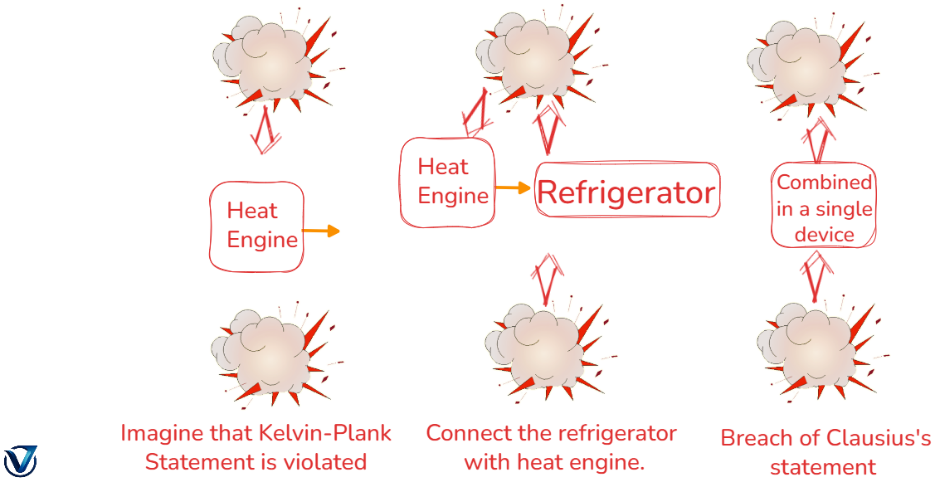
The Clausius and Kelvin‑Planck statements are equivalent. A device that violates the Clausius statement would also violate the Kelvin‑Planck statement, and vice versa.
Perpetual Motion Machine of the Second Kind (PMM2)
A perpetual motion machine of the second kind (PMM2) is a hypothetical device that produces work while interacting with only a single heat reservoir. Such a device would violate the second law of thermodynamics, because it would convert heat entirely into work without rejecting any waste heat.
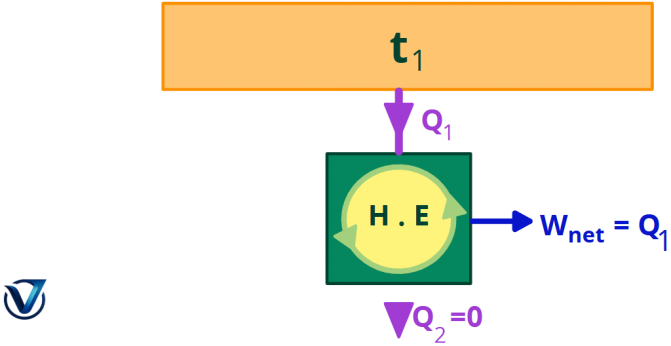
Consequently, a heat engine must interact with at least two thermal reservoirs at different temperatures to produce work in a cycle. Mechanical work can be generated as long as a temperature difference exists. The engine will continue to produce work until the temperatures of the two finite‑heat‑capacity bodies equalize.
Applications of the Second Law of Thermodynamics
- Heat engines (Otto, Diesel cycles): The law dictates that heat always flows from a hotter body to a colder body. This principle governs all heat engine cycles and has driven advancements in modern automobiles.
- Refrigerators and heat pumps: The Reversed Carnot Cycle uses external work to transfer heat from a low‑temperature body to a high‑temperature body. This is the practical basis for refrigeration and air conditioning.
Is it Feasible to Eliminate \(Q_{\text{out}}\)
In a steam power plant, the condenser rejects large amounts of waste heat to rivers, lakes, or the atmosphere. One might ask: can we remove the condenser to save all that wasted energy? The answer is no. Without a heat rejection process, the cycle cannot be completed. Cyclic equipment such as steam power plants cannot operate continuously unless the thermodynamic cycle is closed.
Consider a simple heat engine used to lift weights, as shown in the figure below. The device consists of a piston‑cylinder arrangement with two sets of stops. The working fluid (gas) is initially at 30°C. 100 kJ of heat is added from a source at 100°C, causing expansion and lifting the loaded piston until it hits the upper stops. The load is then removed, and the gas temperature rises to 90°C. The work done on the load is 15 kJ. Even under ideal conditions (no friction, no thermal losses, quasi‑equilibrium), the heat input exceeds the work done because some heat raises the gas temperature.
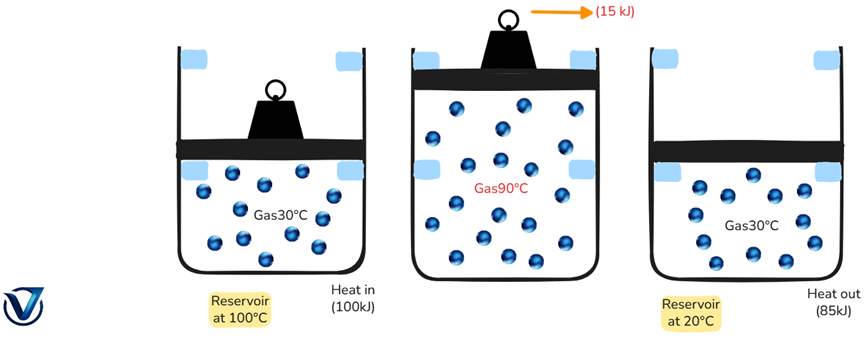
Now, can we transfer the 120 kJ of surplus heat at 80°C back into a reservoir maintained at 110°C for reuse? Under ideal conditions, this would imply a 100% efficient heat engine, which violates the second law. Heat naturally flows from a hotter body to a colder one, never in the opposite direction without external work. To cool the gas from 80°C back to 25°C, we must reject energy to a low‑temperature reservoir (e.g., at 15°C). This rejected energy is waste heat – irretrievable and correctly classified as lost energy.
From this discussion we conclude: every heat engine must reject some energy to a low‑temperature reservoir to operate continuously. This rejected energy is the unavoidable \(Q_{\text{out}}\) demanded by the second law.
Key Takeaways
- The second law introduces entropy as a measure of disorder; total entropy of an isolated system always increases.
- Kelvin‑Planck: No heat engine can have 100% efficiency – some waste heat must be rejected.
- Clausius: Heat cannot spontaneously flow from cold to hot without external work input.
- A perpetual motion machine of the second kind (PMM2) violates the second law.
- Practical applications include internal combustion engines, refrigerators, heat pumps, and power plants.