Chemistry Topics Covered
Chemistry is the science behind everything around us, from the air we breathe and the food we eat to medicines, fuels, and materials. It explores how atoms and molecules combine, react, and transform, helping us understand natural processes and develop new technologies for a better life.
Physical Chemistry
Physical Chemistry deals with the laws and principles governing chemical systems, focusing on energy changes, reaction rates, molecular behavior, and quantitative relationships. It includes topics like thermodynamics, electrochemistry, chemical kinetics, quantum chemistry, surface chemistry, and equilibrium, which are essential for understanding how and why chemical reactions occur.
Electromagnetic Spectrum – Arrangement of electromagnetic radiations in increasing order of wavelength or decreasing frequency.
Photoelectric Effect – Emission of electrons from a metal surface when light of sufficient frequency strikes it.
Bohr’s Atomic Model – Explains hydrogen atom spectrum using quantized circular orbits of electrons.
- Radius of Revolving Electron in Bohr’s Atomic Model
- Energy of Revolving Electron in Bohr’s Atomic Model
de Broglie Equation: Wave–Particle Duality – Matter and radiation exhibit both wave and particle nature.
Davisson-Germer Experiment – Dual Nature of Matter
Heisenberg Uncertainty Principle – Position and momentum of a particle cannot be simultaneously determined with certainty.
Postulates of Quantum Mechanics– the state of a system is described by a wave function (ψ) containing all information about the system
Wave Function (Ψ): Eigen Values and Eigen Functions – Mathematical function describing the quantum state of a particle.
Born Interpretation of wave function – Square of wave function gives probability of finding a particle.
Probability Density – |Ψ|² represents probability per unit volume.
Eigenfunctions and Eigenvalues – Solutions of wave equation giving allowed energy values.
Hamiltonian Operator – Total energy operator (kinetic + potential energy).
Schrödinger Wave Equation – Fundamental equation of quantum mechanics describing wave behavior of particles:
- 3D Box – Energy quantization in three-dimensional confinement.
- 1D Box – Quantization of energy in a confined system.
Conductance and its measurement– Measure of the ability of a solution to conduct electric current.
Kohlrausch’s Law – Limiting molar conductance is the sum of individual ionic conductances.
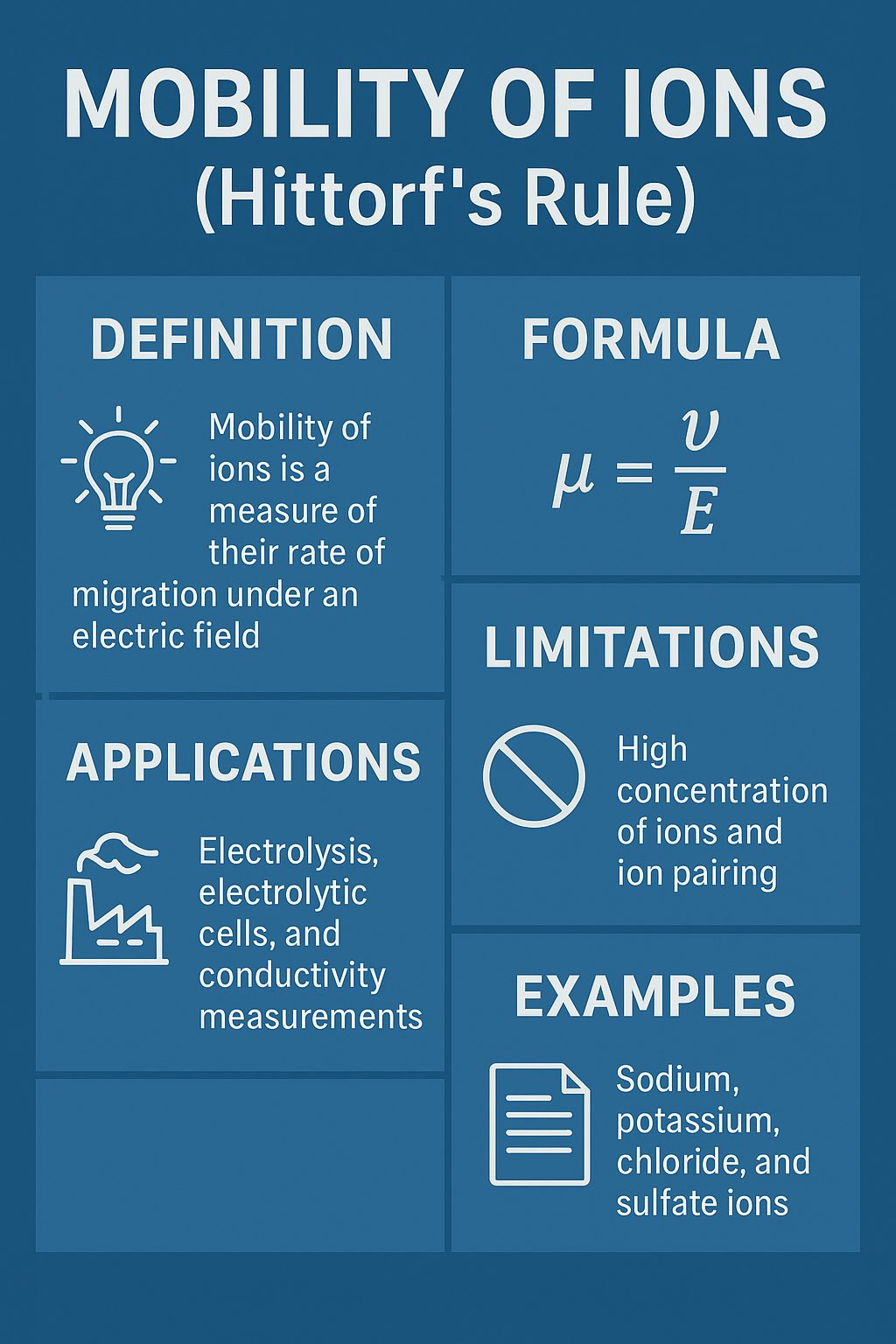
Hittorf’s Rule and Transport Number – Fraction of total current carried by a particular ion.
Conductometric Titrations – Quantitative determination of concentration using a standard solution.
Debye–Hückel Theory – Explains deviation of strong electrolytes from ideal behavior.
Activity Coefficient – Factor relating activity to concentration of an ion.
Redox Reactions – Reactions involving simultaneous oxidation and reduction.
Spontaneous and Non spontaneous Reactions
Electrochemical and Electrolytic Cells – Devices converting chemical energy into electrical energy and vice versa.
Electrode Potentials – Measure of tendency of an electrode to lose or gain electrons.
Nernst Equation – Relates electrode potential to concentration of ions.
Fuel Cells – Electrochemical cells producing electricity directly from fuel oxidation.
Corrosion – Gradual destruction of metals due to electrochemical reactions.
- Van der Waals Equation – Modified gas equation correcting intermolecular forces and volume.
Gas Laws – Mathematical relations between pressure, volume, temperature, and amount of gas.
Ideal and Real Gases – Gases that deviate from ideal behavior at high pressure and low temperature.
Critical Constants and Critical Phenomena – Critical temperature, pressure, and volume defining gas–liquid equilibrium.
Laws of Thermodynamics – Fundamental laws governing energy and entropy changes.
- Zeroth Law of Thermodynamics –
- First Law of Thermodynamics
- Second Law of Thermodynamics
- Third Law of Thermodynamics
Thermochemistry – Study of heat changes accompanying chemical reactions.
Calorimetry – Experimental measurement of heat absorbed or released.
Heat Capacities and Specific Heat – Amount of heat required to raise temperature of a system.
Reversible and Irreversible Processes –
Hess’s Law and Born Haber Cycle – Enthalpy change depends only on initial and final states. Thermochemical cycle for calculating lattice energy of ionic solids.
Entropy (S) and Free Energy and Equilibrim Relation – Measure of randomness or disorder of a system.
Gibbs Free Energy (G) and Gibbs Equation – Criterion for spontaneity of reactions at constant T and P.
Equilibrium Constant – Ratio expressing extent of reaction at equilibrium.
Helmholtz Equation – Relates Helmholtz free energy with work at constant volume.
Fugacity and Activity – Effective pressure accounting for non-ideality of real gases and Effective concentration of a species in non-ideal systems.
Molecularity and Order of Reaction – Number of reacting species involved in an elementary reaction, Sum of powers of concentration terms in the rate law:
Reaction Rates – Change in concentration of reactants or products per unit time.
Order of Reaction –
- Zero Order – Rate independent of reactant concentration.
- First Order – Rate proportional to concentration of one reactant.
- Second Order – Rate proportional to square of concentration or product of two concentrations.
- Third Order – Rate proportional to cube of concentration or combination of three species.
Half-Life – Time required for concentration of a reactant to become half of its initial value.
Methods for Order Determination – Experimental methods to determine reaction order.
Collision Theory – Reaction occurs due to effective collisions with proper energy and orientation.
Transition State Theory – Reaction proceeds through formation of an activated complex.
Activation Energy and Catalysis –
Arrhenius Equation – Relates rate constant with temperature and activation energy.
Complex Reactions – Reactions occurring via more than one elementary step:
- Chain Reactions – Reactions involving initiation, propagation, and termination steps.
- Parallel Reactions – One reactant forms different products simultaneously.
- Series (Consecutive) Reactions – Product of one step becomes reactant of next step.
- Reversible Reactions – Forward and backward reactions occur simultaneously.
Properties of Liquids – Intermolecular forces, viscosity, surface tension, capillarity; physical and chemical properties of surfaces.
Surface Area Determination – Methods to measure surface area of solids, powders, and catalysts.
- Physical Adsorption (Physisorption) – Weak van der Waals forces, reversible.
- Chemical Adsorption (Chemisorption) – Strong chemical bonds, usually irreversible.
Adsorption Isotherms – Relationship between amount adsorbed and pressure/concentration at constant temperature:
- Langmuir Isotherm – Monolayer adsorption on homogeneous surfaces.
- Freundlich Isotherm – Multilayer adsorption on heterogeneous surfaces.
Colloids – Dispersed systems:
- Properties – Tyndall effect, Brownian motion, stability.
- Classification – Lyophilic, lyophobic, association colloids.
- Preparation – Condensation, dispersion methods.
Surfactants – Surface-active agents; reduce surface tension, form micelles; used in detergents and emulsions.
Gibbs Phase Rule – Gibbs phase rule: F = C – P + 2; applied to:
- One-Component Systems – e.g., water, CO₂.
- Two-Component Systems – e.g., salt-water, alloys.
Catalysis Explained Thoroughly – Process speeding up reactions:
- Enzyme Catalysis – Biological catalysts; substrate binding, active site, specificity.
- Homogeneous Catalysis – Catalyst in same phase as reactants.
- Heterogeneous Catalysis – Catalyst in different phase; adsorption important.
- Acid-Base Catalysis – Proton donor/acceptor accelerates reaction.
ANALYTICAL / APPLIED PHYSICAL CHEMISTRY
Analytical Chemistry involves the identification, separation, and quantitative analysis of chemical substances. It covers separation techniques like chromatography and solvent extraction, spectroscopic methods, electrophoresis, statistical data analysis, chemometrics, and error analysis used in laboratory and industrial quality control.
Sampling – Selection of a representative portion of a material for analysis.
Significant Figures – Digits indicating the precision of a measured quantity.
Stoichiometry – Quantitative relationship between reactants and products in reactions.
Errors – Deviation of a measured value from the true value.
Analysis of Variance (ANOVA) – Statistical method to compare variability among datasets.
Arithmetic Mean – Average value obtained by dividing sum of observations by their number.
Median – Middle value of an ordered data set.
Mode – Most frequently occurring value in a data set.
Standard Deviation – Measure of spread or dispersion of data around the mean.
Confidence Limits – Range within which the true value is expected to lie with certainty.
Gaussian Distribution – Normal distribution of data about the mean value.
Least Square Method – Technique to obtain best-fit line by minimizing errors.
Statistical Tests – Procedures to evaluate reliability and significance of analytical data.
Solvent Extraction – Separation of components based on differential solubility in two immiscible solvents.
Metal Separations – Selective extraction and isolation of metals from mixtures.
Batch Extraction – Extraction carried out in discrete steps using fresh solvent each time.
Counter-Current Extraction – Continuous extraction where solvent and solute move in opposite directions.
Chromatography – Separation technique based on differential distribution between stationary and mobile phases:
- Paper Chromatography – Separation using paper as stationary phase.
- Thin Layer Chromatography (TLC) – Separation on thin adsorbent-coated plates.
- Column Chromatography – Separation through adsorption in a packed column.
- Ion Exchange Chromatography – Separation based on ionic interactions.
Electrophoresis – Separation of charged particles under an electric field.
- Protein Electrophoresis – Separation of proteins based on charge and size.
INORGANIC CHEMISTRY
Inorganic Chemistry studies the properties, structures, bonding, and reactions of elements and their compounds, excluding most carbon-based substances. This branch covers chemical bonding theories, coordination chemistry, acids and bases, p-block elements, d- and f-block elements, transition metals, and their industrial and biological importance.
Types of Chemical Bonding – Forces that hold atoms together:
- Ionic Bonding – Electrostatic attraction between oppositely charged ions.
- Covalent Bonding – Sharing of electron pairs between atoms.
- Metallic Bonding – Delocalized electrons holding metal cations together.
- Coordinate (Dative) Bonding – Both bonding electrons provided by one atom.
- Hydrogen Bonding – Attraction between hydrogen and electronegative atoms.
- Van der Waals Forces – Weak intermolecular forces (dipole-dipole, London, hydrogen bonding).
Valence Bond Theory (VBT) – Explains bonding through overlap of atomic orbitals.
Hybridization – Mixing of atomic orbitals to form equivalent hybrid orbitals.
Resonance – Representation of a molecule by two or more contributing structures.
VSEPR Theory – Predicts molecular shape based on electron pair repulsions.
Molecular Orbital Theory (MOT) – Describes bonding using molecular orbitals:
- Diatomic Molecules – Application of MOT to homonuclear and heteronuclear diatomics.
Delocalized Bonding – Bonding involving electrons spread over several atoms.
Electron-Deficient Bonding – Bonding with fewer electrons than required by classical theory.
p-Block Elements – Elements of Groups 13–18 and their physical and chemical properties.
Chemical Equilibrium – State where forward and reverse reaction rates are equal.
Acid–Base Theories – Concepts explaining acid and base behavior:
- Arrhenius Theory – Acids produce H⁺, bases produce OH⁻ in water.
- Brønsted–Lowry Theory – Acids donate protons, bases accept protons.
- Lewis Theory – Acids accept electron pairs, bases donate electron pairs.
- SHAB Concept – Hard and soft acids and bases classification.
Acid/Base Strength – Relative tendency to donate or accept protons.
pH – Measure of hydrogen ion concentration in solution.
Significance of pKw, pKa & pKb – Negative logarithms of acid and base dissociation constants.
Buffers – Solutions resisting change in pH upon addition of acid or base.
Indicators – Substances showing color change at specific pH range.
Solubility – Maximum amount of solute that dissolves in a solvent.
Solubility Product (Ksp) – Equilibrium constant for dissolution of sparingly soluble salts.
Common Ion Effect – Decrease in solubility of a salt due to presence of a common ion.
Characteristics of d- and f-Block Elements – General properties, trends, and reactivity.
Coordination Chemistry – Study of complexes formed by central metal ions with ligands:
- Nomenclature – IUPAC rules for naming coordination compounds.
- Structures & Coordination Number (2–10) – Geometry of complexes based on CN.
- Chelates & Chelate Effect – Multidentate ligands forming stable ring complexes.
Theories of Coordination Compounds – Explaining bonding and structure:
- Werner’s Theory – Primary and secondary valency concept.
- Valence Bond Theory (VBT) – Hybridization and bonding in complexes.
- Crystal Field Theory (CFT) – Splitting of d-orbitals in ligand field.
- Molecular Orbital Theory (MOT) – Molecular orbital approach for complexes.
Jahn–Teller Effect – Distortion in certain octahedral complexes to lower energy.
Magnetic & Spectral Properties – Paramagnetism, diamagnetism, electronic spectra.
Isomerism – Structural and stereoisomerism in complexes.
Lanthanides – General characteristics, oxidation states, lanthanide contraction, separation.
Actinides – General properties, oxidation states, electronic configuration, half-life & decay laws.
ORGANIC CHEMISTRY
Organic Chemistry focuses on carbon-containing compounds, their structures, properties, reactions, and mechanisms. It includes hydrocarbons, aromatic compounds, functional groups, stereochemistry, reaction mechanisms, spectroscopy, and synthesis, forming the foundation of pharmaceuticals, polymers, fuels, and biomolecules.
Bonding – Types of chemical bonds and interactions between atoms.
Hybridization – Mixing of atomic orbitals to form equivalent hybrid orbitals.
Inductive Effect – Electron-withdrawing or donating effect transmitted through sigma bonds.
Resonance – Delocalization of electrons represented by multiple contributing structures.
Hyperconjugation – Delocalization of electrons through sigma bonds adjacent to π systems or carbocations.
Dipole Moment – Measure of polarity of a molecule due to separation of charges.
Alkanes – Saturated hydrocarbons:
- Nomenclature – IUPAC rules for naming alkanes.
- Physical Properties – Boiling/melting points, solubility, density trends.
- Preparation – Methods like Wurtz reaction, hydrogenation of alkenes, halide reduction.
- Reactions – Combustion, free radical halogenation, cracking, isomerization.
Alkenes – Unsaturated hydrocarbons with C=C:
- Nomenclature – IUPAC rules for naming alkenes.
- Physical Properties – Boiling/melting points, solubility, density trends.
- Preparation – Dehydration of alcohols, dehydrohalogenation, cracking of alkanes.
- Reactions – Electrophilic addition, hydrogenation, polymerization, oxidation.
Alkynes – Unsaturated hydrocarbons with C≡C:
Reactions – Electrophilic addition, hydration, halogenation, oxidation, polymerization.
Nomenclature – IUPAC rules for naming alkynes.
Physical Properties – Boiling/melting points, acidity of terminal H, solubility trends.
Preparation – Dehalogenation of dihalides, acetylene from CaC₂, alkyne synthesis via alkylation.
Benzene Structure – Planar cyclic molecule with delocalized π-electrons forming a stable ring.
Aromaticity – Concept of extra stability in cyclic, conjugated, planar molecules following Hückel’s rule (4n+2 π electrons).
Electrophilic Substitution – Reactions where a hydrogen atom is replaced by an electrophile (e.g., nitration, halogenation, sulfonation).
Substituent Effects – Influence of existing groups on reactivity and orientation:
Deactivating Groups – Decrease reactivity, meta-directing.
Activating Groups – Increase reactivity, ortho/para-directing.
Alcohols – Compounds with –OH group:
- Physical & Chemical Properties, Applications – Hydrogen bonding, high boiling points, oxidation, dehydration, esterification; used as solvents, fuels, intermediates.
- Preparation – Hydration of alkenes, reduction of carbonyls, fermentation of sugars.
- Reactions – Oxidation (to aldehydes/ketones/acids), dehydration (to alkenes), esterification; mechanism included.
2. Phenols – Aromatic –OH compounds:
- Physical & Chemical Properties, Applications – Acidic, hydrogen bonding, undergo electrophilic substitution; used in antiseptics, dyes.
- Preparation – From aromatic halides, cumene process, diazonium salts.
- Reactions – Electrophilic substitution (halogenation, nitration), oxidation, esterification; mechanisms.
3. Ethers – R–O–R’ compounds:
- Physical & Chemical Properties, Applications – Low polarity, stable under neutral conditions, cleavage with HX; used as solvents.
- Preparation – Williamson synthesis, dehydration of alcohols.
- Reactions – Cleavage with hydrogen halides, limited reactivity.
4. Amines – Nitrogen-containing compounds (R–NH₂, R₂NH, R₃N):
- Physical & Chemical Properties, Applications – Basic, hydrogen bonding, form amides, used in dyes and pharmaceuticals.
- Preparation – Reduction of nitro compounds, amides, alkyl halides.
- Reactions – Acylation, alkylation, diazotization; reaction mechanisms.
5. Alkyl Halides – R–X compounds:
- Physical & Chemical Properties, Applications – Polar, higher boiling points, intermediates in synthesis.
- Preparation – Halogenation of alkanes, alcohol conversion.
- Reactions – Nucleophilic substitution (SN1/SN2), elimination (E1/E2).
6. Grignard Reagent – RMgX compounds:
- Physical & Chemical Properties, Applications – Highly nucleophilic/basic; used for forming alcohols, acids, ketones.
- Preparation – Reaction of alkyl/aryl halides with Mg in dry ether.
- Reactions – Nucleophilic addition to carbonyl compounds; mechanism.
7. Carbonyl Compounds (Aldehydes & Ketones):
- Physical & Chemical Properties, Applications – Polar, higher boiling points, undergo nucleophilic addition; industrial and lab applications.
- Preparation – Oxidation of alcohols, ozonolysis, Friedel–Crafts acylation.
- Reactions – Nucleophilic addition, condensation, oxidation/reduction; mechanisms.
8. Carboxylic Acids & Derivatives (R–COOH, R–COX, R–COOR, R–CONH₂):
- Physical & Chemical Properties, Applications – Hydrogen bonding, acidic, high boiling points; used in ester, amide synthesis.
- Preparation – Oxidation of aldehydes/alcohols, hydrolysis of nitriles/esters.
- Reactions – Formation of acid halides, anhydrides, esters, amides via nucleophilic acyl substitution; mechanisms included.
Nucleophilic Substitution (S) – Replacement of leaving group by nucleophile (SN1 & SN2); used in synthesis of alcohols, amines.
Elimination (E) – Removal of HX to form alkenes (E1 & E2); depends on substrate, base, and conditions.
Zaitsev Rule – More substituted alkene is major product in elimination.
Hofmann Rule – Less substituted alkene is major when bulky base is used.
Competition – Substitution vs elimination depends on nucleophile/base strength, solvent, temperature.
UV/Visible Spectroscopy – Study of electronic transitions; used for conjugated systems, determination of λmax.
IR Spectroscopy – Study of vibrational transitions; identifies functional groups via characteristic absorption.
¹H NMR Spectroscopy – Study of hydrogen nuclei environments; provides information on structure, number of protons, and splitting patterns.
Mass Spectrometry – Study of molecular mass and fragmentation; used for molecular weight determination and structure elucidation.
Biochemistry
Biochemistry explores the chemical processes occurring in living organisms. It includes the structure and function of biomolecules such as carbohydrates, lipids, proteins, nucleic acids, enzymes, and metabolic pathways like glycolysis, Krebs cycle, and photosynthesis.
Carbohydrates – Sugars and polysaccharides; energy sources and structural roles.
Lipids – Fats, oils, and membranes; energy storage and cell structure.
Amino Acids – Building blocks of proteins; structure determines function.
Proteins (Structures) – Polymers of amino acids; primary, secondary, tertiary, and quaternary forms.
Nucleic Acids – DNA and RNA; genetic information storage and transfer.
Enzymes – Biological catalysts; speed up chemical reactions.
Inhibition – Factors reducing enzyme activity; competitive and non-competitive types.
Kinetics – Study of reaction rates; enzyme-catalyzed reaction speed.
Digestion & Absorption of Biomolecules – Breakdown and uptake of carbs, fats, and proteins.
Glycolysis – Glucose breakdown to pyruvate for energy production.
TCA Cycle – Krebs cycle; central energy-producing pathway in mitochondria.
Gluconeogenesis – Formation of glucose from non-carbohydrate precursors.
Photosynthesis – Conversion of light energy into chemical energy in plants.
Biosynthesis of Fats/Steroids – Formation of lipids and steroid molecules in cells.
Urea Cycle – Detoxification of ammonia to form urea.
Nucleoside Catabolism – Breakdown of nucleotides into nitrogenous bases and sugars.
Chemical Industries
Industrial Chemistry applies chemical principles to large-scale manufacturing processes. It covers the production and processing of materials such as fertilizers, cement, glass, sugar, paper, soaps, and detergents, emphasizing efficiency, sustainability, and economic importance
Sugar – Extraction, refining, and crystallization of sugar.
Cement – Production and processing for construction materials.
Glass – Melting and shaping of silica-based materials.
Paper – Pulping, bleaching, and sheet formation from plant fibers.
Fertilizers – Chemical production to enrich soil for crops.
Soap & Detergents – Saponification and formulation for cleaning purposes.
Suggested Readings
| S.No | Title | Author(s) |
| 1 | Physical Chemistry (4th ed., 2005) | Silbey, Alberty, Bawendi |
| 2 | Physical Chemistry: A Molecular Approach (1997) | McQuarrie, Simon |
| 3 | Atkin’s Physical Chemistry (9th ed., 2010) | Atkins, Paula |
| 4 | Physical Chemistry (4th ed., 1972) | Moore, W. J. |
| 5 | Modern Analytical Chemistry (2000) | Harvey, D. |
| 6 | Quantitative Chemical Analysis (8th ed., 2011) | Harris, D. C. |
| 7 | Analytical Chemistry (6th ed., 2006) | Christian, G. D. |
| 8 | Chemometrics (2nd ed., 2007) | Matthios, O. |
| 9 | Statistics & Chemometrics (5th ed., 2005) | Miller, J. & J. |
| 10 | Separation Chemistry (2004) | Budhiraja, R. P. |
| 11 | Advanced Inorganic Chemistry (6th ed., 2007) | Cotton, Wilkinson |
| 12 | Inorganic Chemistry (4th ed., 2010) | Miessler, Tarr |
| 13 | Inorganic Chemistry (5th ed., 2010) | Shriver, Atkins |
| 14 | Textbook of Inorganic Chemistry (2013) | Chaudhary, S. U. |
| 15 | Organic Chemistry (10th ed., 2011) | Solomons, Fryhle |
| 16 | Organic Chemistry (6th ed., 2012) | Brown, Iverson et al. |
| 17 | Organic Chemistry (8th ed., 2012) | John, E. M. |
| 18 | Introduction to Spectroscopy (4th ed., 2009) | Pavia, Lampman, Kriz, Vyvyan |
| 19 | Spectrometric ID of Organic Compounds (2005) | Silverstein, Webster, Kiemle |
| 20 | Organic Spectroscopy (2006) | Younas, M. |
| 21 | Stereochemistry (2002) | Morris, D. G. |
| 22 | Shreve’s Chemical Process Industries (5th ed., 1984) | Shreve, Austin |
| 23 | Riegel’s Handbook of Industrial Chemistry (2003) | Riegel, Kent |

Proudly powered by WordPress