
Arrhenius Equation: Temperature Dependence of Reaction Rates
The Arrhenius equation is a cornerstone of chemical kinetics. It quantitatively describes how the rate constant of a chemical reaction varies with temperature and activation energy. Proposed by Svante Arrhenius in 1889, it provides a deep connection between molecular energy distributions and observable reaction rates, and is essential for predicting reaction behaviour in industrial processes, atmospheric chemistry, and biological systems.
where:
- \(k\) = rate constant (units depend on reaction order)
- \(A\) = pre‑exponential factor (frequency factor) – same units as \(k\); represents the frequency of collisions with proper orientation
- \(E_a\) = activation energy (J/mol or kJ/mol)
- \(R\) = universal gas constant = 8.314 J·mol⁻¹·K⁻¹
- \(T\) = absolute temperature (K)
Activation Energy and Collision Theory
According to collision theory, a reaction proceeds only when reactant molecules collide with sufficient kinetic energy and proper orientation. The threshold energy is the minimum energy required for an effective collision. Activation energy (\(E_a\)) is the extra energy that reactant molecules must acquire to reach this threshold.
The fraction of molecules with kinetic energy equal to or greater than \(E_a\) is given by the Boltzmann factor \(e^{-E_a/(RT)}\). Only this fraction can undergo a successful reaction.
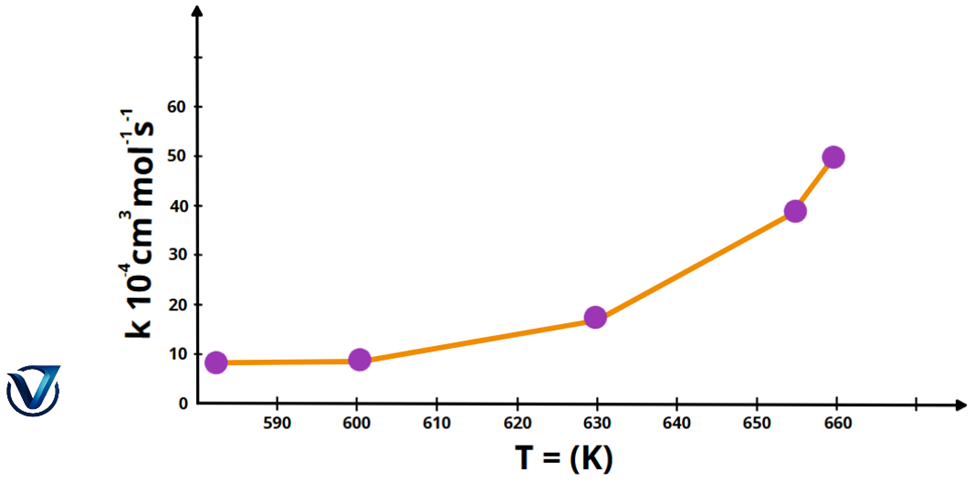
Temperature Coefficient
For many reactions, the rate constant roughly doubles for every 10 °C rise in temperature. This empirical observation is expressed as the temperature coefficient:
Typical values range from 2 to 3, though variations exist. The Arrhenius equation provides the theoretical basis for this behaviour.
Graphical Representation: The Arrhenius Plot
Taking natural logarithms on both sides of the Arrhenius equation yields a linear form:
When \(\ln k\) is plotted against \(1/T\) (Kelvin⁻¹), a straight line is obtained:
- Slope \(m = -\dfrac{E_a}{R}\)
- Intercept \(= \ln A\)
Thus, the activation energy can be determined from the slope: \(E_a = -m \times R\).
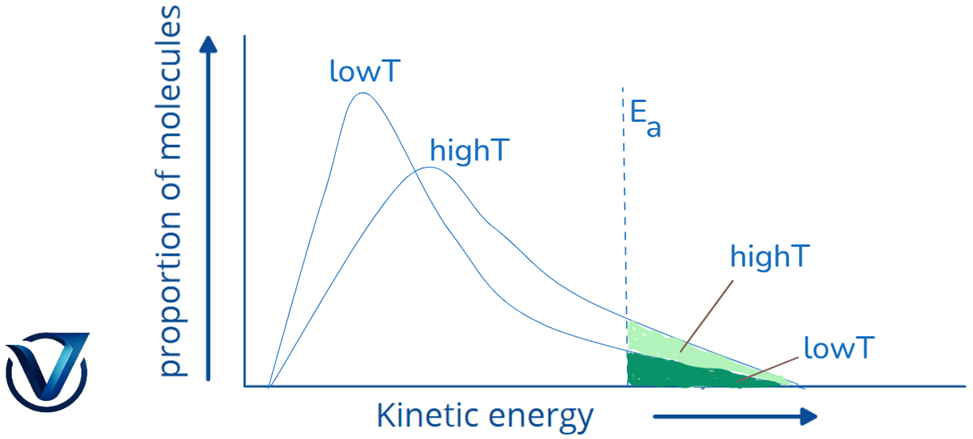
Effect of Temperature on Molecular Energy Distribution
As temperature increases, the kinetic energy distribution shifts to higher energies. The area under the tail of the curve beyond \(E_a\) grows significantly, explaining the exponential increase in the rate constant.
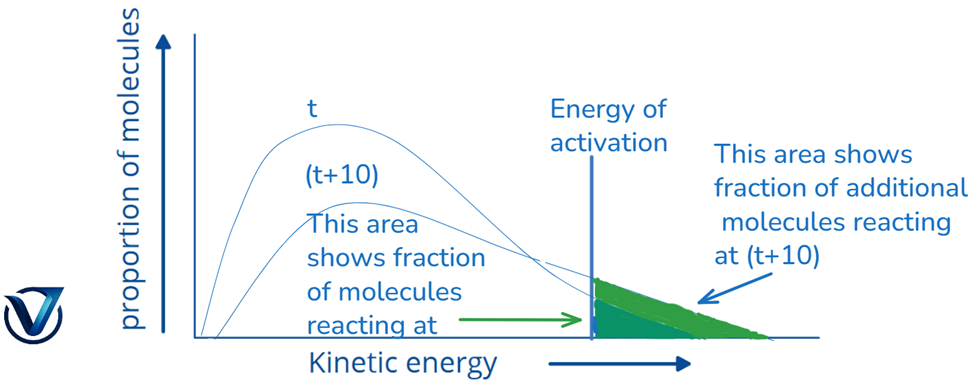
Two‑Point Form of the Arrhenius Equation
When rate constants \(k_1\) and \(k_2\) are known at temperatures \(T_1\) and \(T_2\), the activation energy can be calculated without needing \(A\). The derivation proceeds as follows:
These relationships allow prediction of rate constants at new temperatures if \(E_a\) is known, or determination of \(E_a\) from two experimental rate measurements.
Effect of a Catalyst on Activation Energy
A catalyst provides an alternative reaction pathway with a lower activation energy, thereby increasing the rate constant without being consumed. Key points:
- The catalyst forms temporary bonds with reactants, creating an intermediate complex that decomposes to products and regenerates the catalyst.
- Only a small amount of catalyst is needed to accelerate a large quantity of reactants.
- A catalyst does not change the thermodynamic equilibrium constant (\(K\)); it only speeds up the attainment of equilibrium.
- Catalysts cannot make a non‑spontaneous reaction occur; they only accelerate spontaneous reactions.
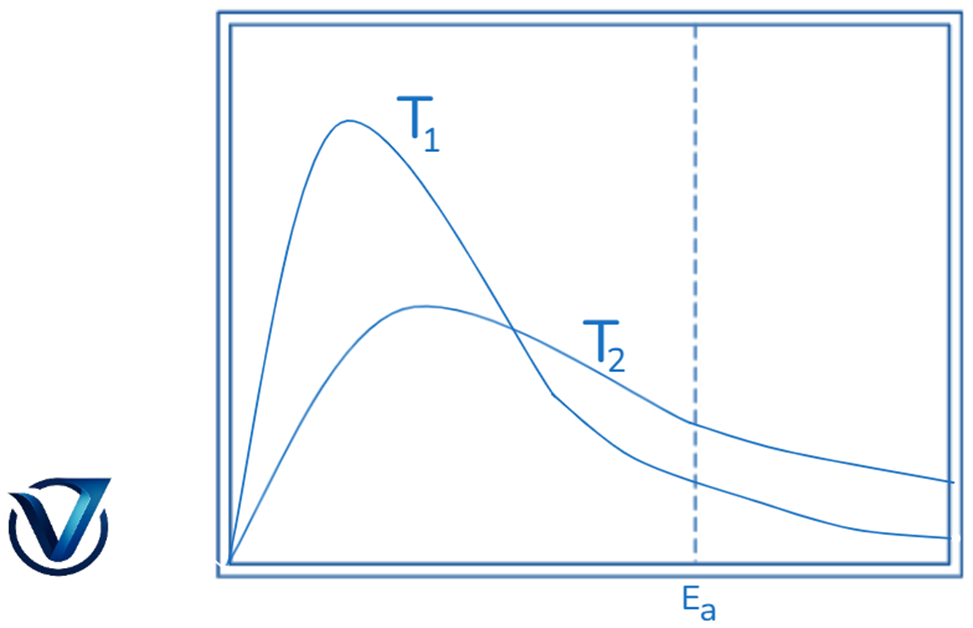
Example: Decomposition of Nitrogen Dioxide
The decomposition of nitrogen dioxide, \(2\text{NO}_2 \rightarrow 2\text{NO} + \text{O}_2\), follows Arrhenius behaviour. Experimentally, the activation energy for this reaction is approximately 114 kJ/mol. The rate constant increases exponentially with temperature, consistent with the Arrhenius equation.
Interactive Arrhenius Calculators
Calculator 1: Ratio of rate constants \(k_2/k_1\)
Calculator 2: Activation Energy from two rate constants
📘 English lecture slot: will be added soon — check back for updates.
Summary of Key Equations
Download Complete Notes Below
Proudly Powered By


Leave a Comment