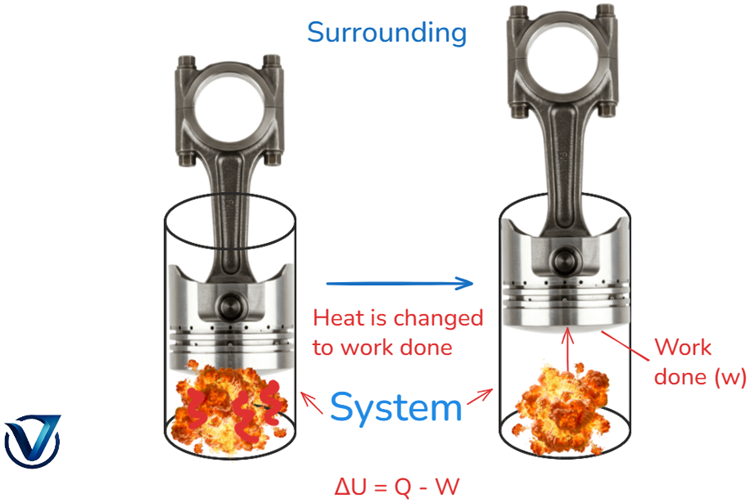
The First Law of Thermodynamics represents the application of the universal Law of Conservation of Energy to macro-systems involving heat and work interactions. It is the cornerstone of chemical kinetics and mechanical engineering, establishing that energy cannot be created or annihilated—only transitioned through different states.
The Mathematical Framework
In any thermodynamic process, the energy balance between a system and its surroundings is captured by the fundamental equation:
Where ΔQ is heat exchanged, ΔU is the change in internal energy, and W is work done.
This law can be rearranged to define the Internal Energy of a system:
Internal Energy: The State Function
Internal energy is the total microscopic energy (kinetic and potential) of the particles within a system. One of the most critical inferences of the First Law is that while Heat (ΔQ) and Work (W) are Path Functions—meaning their values depend on how a change occurred—the quantity (ΔQ – W) is invariant.
Regardless of the path taken to reach a new state, ΔU remains the same. Thus, internal energy is a State Function. In an Isolated System, where no heat or work exchange occurs, ΔU is always zero, reinforcing the principle of conservation.
Sign Conventions in Thermodynamics
For competitive exams, mastering sign conventions is vital. The direction of energy flow dictates whether the values in your calculations are positive or negative:
| Interaction | Condition | Sign of Energy |
|---|---|---|
| Heat (ΔQ) | Added to the system | Positive (+) |
| Heat (ΔQ) | Removed from the system | Negative (–) |
| Work (W) | Done on the system (Compression) | Positive (+) |
| Work (W) | Done by the system (Expansion) | Negative (–) |
Thermodynamic Processes & The First Law
The First Law adapts specifically to different types of thermodynamic processes:
In summary, the First Law provides the quantitative bridge between thermal energy and mechanical work. It ensures that every joule of energy is accounted for, whether it remains within the system as internal energy or is transferred across boundaries as work or heat.
Pressure-Volume (PV) Work: Complete Formula Derivation and Thermodynamic Significance
In the study of thermodynamics, mechanical work is most frequently observed as Pressure-Volume (PV) work. This occurs whenever a system’s boundary moves—such as a gas expanding in a cylinder—against an external force. Understanding this derivation is fundamental for students transitioning from basic physics to advanced chemical thermodynamics.
The Step-by-Step Mathematical Derivation
To derive the formula for work done by a gas, consider a frictionless piston of cross-sectional area A acting on a gas within a cylinder. If the gas expands against an external pressure P, moving the piston by a small distance dx, the derivation follows these logical steps:
Variables and Units in PV Work
For accurate calculations in competitive exams, ensure all variables are in SI units:
| P (Pressure) | Measured in Pascals (Pa) or Newtons per square meter (N/m²) |
| ΔV (Volume Change) | Measured in cubic meters (m³) |
| W (Work) | Measured in Joules (J) |
This derivation demonstrates that the internal energy of a system is not just a static value but a dynamic one that fluctuates based on work interactions at its boundaries. When work is performed on the system, internal energy increases; conversely, it decreases when work is performed by the system.
Pressure-Volume (PV) Work: Complete Formula Derivation and Thermodynamic Significance
In the study of thermodynamics, mechanical work is most frequently observed as Pressure-Volume (PV) work. This occurs whenever a system’s boundary moves—such as a gas expanding in a cylinder—against an external force. Understanding this derivation is fundamental for students transitioning from basic physics to advanced chemical thermodynamics.
The Step-by-Step Mathematical Derivation
To derive the formula for work done by a gas, consider a frictionless piston of cross-sectional area A acting on a gas within a cylinder. If the gas expands against an external pressure P, moving the piston by a small distance dx, the derivation follows these logical steps:
Variables and Units in PV Work
For accurate calculations in competitive exams, ensure all variables are in SI units:
| P (Pressure) | Measured in Pascals (Pa) or Newtons per square meter (N/m²) |
| ΔV (Volume Change) | Measured in cubic meters (m³) |
| W (Work) | Measured in Joules (J) |
This derivation demonstrates that the internal energy of a system is not just a static value but a dynamic one that fluctuates based on work interactions at its boundaries. When work is performed on the system, internal energy increases; conversely, it decreases when work is performed by the system.
Real-World Applications of the First Law of Thermodynamics in Engineering and Science
The First Law of Thermodynamics is not merely a theoretical construct; it is a practical tool used to calculate energy efficiency and design the systems that power modern civilization. From the engines in our vehicles to the metabolic processes in our bodies, the conservation of energy is always at work.
Energy Production & Utilization
The first rule of thermodynamics is employed to forecast the efficiency of energy conversion processes. This includes transforming heat into mechanical work in steam turbines or turning chemical energy into electrical energy in a battery. It is essential for analyzing engine performance and developing sustainable energy technologies.
Refrigeration & Air Conditioning
Engineers utilize the first law to comprehend the behavior of refrigerants. This knowledge is used to engineer refrigeration and air conditioning systems that are both efficient and effective in environmental cooling, ensuring maximum heat removal with minimum work input.
Advanced Heat Transfer
The law elucidates the dynamics of heat transfer mechanisms, including conduction, convection, and radiation. It is the primary guide for the design of heat exchangers and other apparatuses that facilitate the transfer of thermal energy from one site to another.
Chemical Reaction Kinetics
In chemistry, the first law is employed to comprehend the kinetics of chemical processes. It allows scientists to anticipate the energy transformations—whether exothermic or endothermic—that transpire throughout such reactions.
Gaseous Thermodynamics
This law elucidates the behavior of gases and forecasts variations in temperature, pressure, and volume. This is vital in industrial operations involving compressed gases, pneumatic systems, and internal combustion engines.
Biological & Medical Systems
The first rule is employed to comprehend the dynamics of biological systems, including human metabolism. In medicine, it is utilized to engineer life-saving technology such as pacemakers and artificial organs that rely on precise energy regulation.
Competitive Exam Summary: Key Takeaways
- Isolated Systems: ΔU is always 0 because no energy enters or leaves.
- State Function: ΔU depends only on the initial and final states, not the path taken.
- Energy Invariant: The quantity (ΔQ – W) remains constant across any path.
- PV Work: Work is done whenever there is a volume change ($W = -PΔV$).