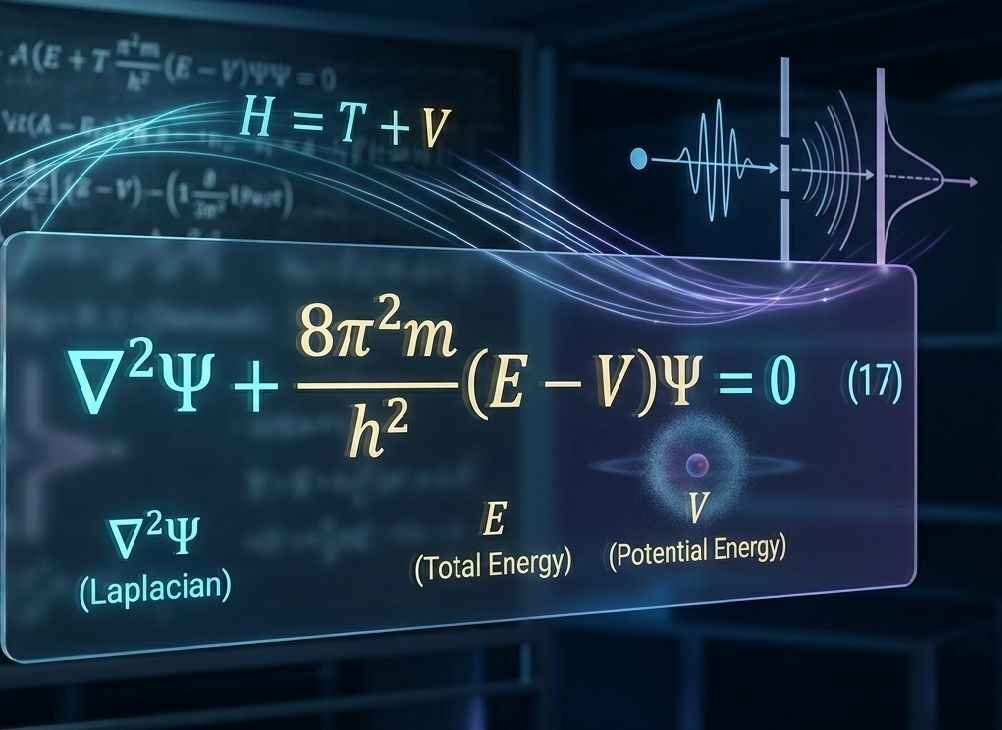
Schrodinger Wave Equation from Quantum Mechanics
Derivation of Schrodinger Wave Equation from Postulates of Quantum Mechanics Time-independent Schrödinger equation The Schrödinger Equation is the fundamental pillar […]

Derivation of Schrodinger Wave Equation from Postulates of Quantum Mechanics Time-independent Schrödinger equation The Schrödinger Equation is the fundamental pillar […]
In Bohr’s atomic model, the radius of a revolving electron in the nth orbit is the distance from the nucleus
The postulates of quantum mechanics state that the state of a system is described by a wave function (ψ) containing
The dual nature of matter means particles like electrons show both wave-like and particle-like behavior. This idea was confirmed by
The Compton effect explains how X-rays or high-energy photons scatter when they collide with electrons. After the collision, the photon
Heisenberg’s uncertainty principle states that it is impossible to measure both the exact position and exact momentum of a particle
A wave function (ψ) in quantum mechanics describes the quantum state of a particle, including its position, momentum, and energy.
Explore the Schrödinger wave equation for 1D and 3D particles in a box, including quantized energy levels and wave functions.
For a particle confined in a one-dimensional box of length L with infinitely high walls, the potential inside the box
The photoelectric effect occurs when light of a certain minimum frequency strikes a metal surface and causes electrons to be