
Hess’s Law of Constant Heat Summation and the Born-Haber Cycle
Hess’s Law of Constant Heat Summation is a fundamental principle of thermochemistry used to calculate enthalpy changes in chemical reactions. It states that the total enthalpy change is independent of the reaction pathway, provided the initial and final states remain the same. This principle is especially useful when a reaction cannot be measured directly.
One of the most important applications of Hess’s Law is the Born-Haber cycle, which helps calculate the lattice energy of ionic compounds such as sodium chloride (NaCl). By combining measurable energy changes, chemists can determine the energy associated with forming an ionic crystal from gaseous ions.
What Is Hess’s Law of Constant Heat Summation?
Hess’s Law states that if a chemical reaction can occur through several steps, the overall enthalpy change is equal to the sum of the enthalpy changes of those steps. The reaction may happen directly or through several intermediate reactions; the total enthalpy change remains the same when the starting and ending states are identical.
This law follows from the fact that enthalpy is a state function. Enthalpy depends on the state of a system, including factors such as its composition, temperature, and pressure, rather than on the specific route taken between two states.
Here, \(\Delta H_{\text{overall}}\) is the enthalpy change for the complete reaction, and each \(\Delta H_i\) represents the enthalpy change of an individual step. Enthalpy changes are commonly reported in kilojoules per mole (kJ mol\(^{-1}\)).
Why Is Hess’s Law Important?
Some chemical reactions are difficult to study experimentally because they occur too quickly, involve several simultaneous reactions, or produce unstable intermediates. Hess’s Law allows chemists to calculate their enthalpy changes by combining data from other reactions.
- It helps determine unknown reaction enthalpies from known thermochemical data.
- It provides the foundation for Born-Haber cycles and lattice energy calculations.
- It allows standard enthalpies of formation to be used to calculate reaction enthalpies.
- It supports energy calculations in industrial chemistry, combustion, and materials science.
How Hess’s Law Works: Direct and Indirect Routes
Imagine converting substance A into substance B. The transformation can occur in a single direct reaction or through intermediate substances such as C, D, and E. Hess’s Law says the total enthalpy change must be the same for every valid route between the same initial and final states.
When applying Hess’s Law, reaction equations can be reversed or multiplied by a factor. Reversing a reaction changes the sign of its enthalpy change, while multiplying the equation by a factor multiplies its enthalpy change by the same factor.
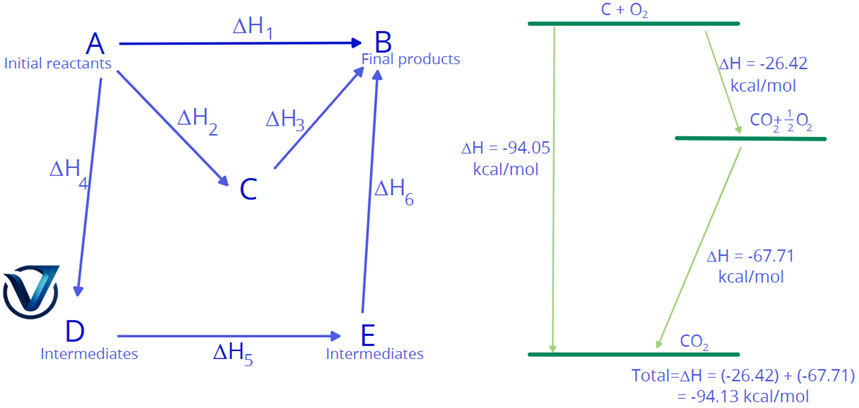
Worked Example: Formation of Carbon Dioxide
Carbon dioxide can form directly from carbon and oxygen or indirectly through carbon monoxide. The two pathways provide a practical demonstration of Hess’s Law of Constant Heat Summation.
Apply Hess’s Law
Add the enthalpy changes for the two indirect steps:
The calculated value matches the direct route. This confirms that the overall enthalpy change is the same for both pathways, illustrating Hess’s Law.
What Is the Born-Haber Cycle?
The Born-Haber cycle is an application of Hess’s Law used to analyze the formation of ionic solids from their constituent elements. It breaks the overall formation reaction into a sequence of theoretical steps involving gaseous atoms and ions.
The cycle is particularly valuable because lattice energy is difficult to measure directly. Instead, the known enthalpy of formation and other experimentally determined energy changes can be combined to calculate the unknown lattice energy.
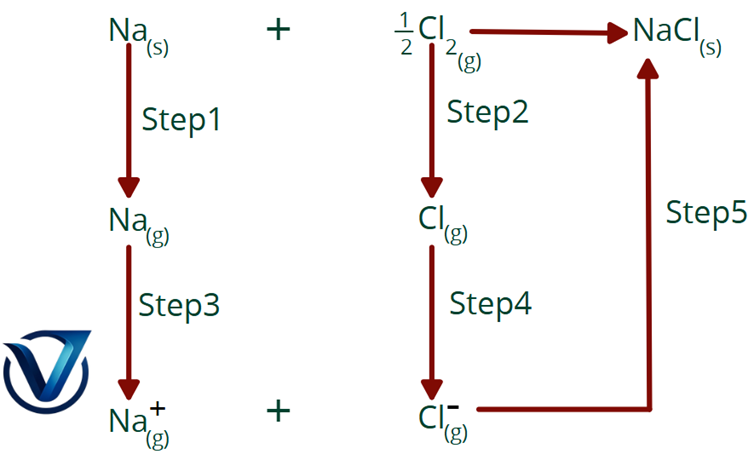
For an ionic compound such as sodium chloride, the cycle accounts for the conversion of sodium metal into gaseous atoms, the dissociation of chlorine molecules, the removal of an electron from sodium, the addition of an electron to chlorine, and the formation of the ionic crystal.
Energy Changes in a Born-Haber Cycle
| Energy term | Meaning | Typical sign |
|---|---|---|
| Enthalpy of formation | Formation of one mole of an ionic compound from its elements in their standard states. | May be positive or negative |
| Sublimation enthalpy | Conversion of a solid metal into gaseous atoms. | Positive |
| Bond dissociation enthalpy | Breaking a bond to form gaseous atoms. | Positive |
| Ionization energy | Removal of an electron from a gaseous atom. | Positive |
| Electron affinity | Energy change when a gaseous atom gains an electron. | Often negative for the first electron affinity |
| Lattice enthalpy of formation | Formation of an ionic solid from gaseous ions. | Negative |
Lattice Energy: Definition and Sign Convention
Lattice energy describes the energy associated with the formation or separation of an ionic crystal and its gaseous ions. Two sign conventions are widely used, so it is essential to identify which convention applies before solving a problem.
- Lattice enthalpy of formation: the enthalpy change when gaseous ions form one mole of an ionic solid. This value is normally negative for a stable ionic crystal.
- Lattice enthalpy of dissociation: the energy required to separate one mole of an ionic solid into gaseous ions. This value is positive.
In the equations below, \(U\) represents the positive lattice dissociation enthalpy. Therefore, the lattice formation enthalpy is written as \(-U\). Keeping this distinction clear prevents sign errors during a Born-Haber calculation.
Born-Haber Cycle for Sodium Chloride (NaCl)
Sodium chloride forms when sodium reacts with chlorine. The standard enthalpy of formation is approximately \(-411\ \mathrm{kJ\,mol^{-1}}\), using the rounded values in this example.
Step 1: Sublimation of Sodium
Solid sodium is converted into gaseous sodium atoms. This process requires energy because the metallic solid must be separated into individual gaseous atoms.
Step 2: Dissociation of Chlorine
Chlorine exists as diatomic molecules, \(\mathrm{Cl_2}\). Because the formation equation uses half a mole of chlorine, only half the bond dissociation enthalpy is included.
Step 3: Ionization of Sodium
A gaseous sodium atom loses one electron to form a positively charged sodium ion. Removing an electron requires energy.
Step 4: Electron Affinity of Chlorine
A gaseous chlorine atom gains an electron to form a chloride ion. The first electron affinity of chlorine is exothermic, so its enthalpy change is negative.
Step 5: Formation of the Ionic Lattice
Gaseous sodium and chloride ions combine to form solid sodium chloride. The strong electrostatic attraction between oppositely charged ions releases energy.
Step-by-Step Lattice Energy Calculation for NaCl
Hess’s Law states that the sum of all five enthalpy changes in the Born-Haber cycle equals the standard enthalpy of formation of sodium chloride.
Substitute the rounded values:
Simplify the known energy changes:
Rearrange to solve for the positive lattice dissociation enthalpy:
Important Equations for Hess’s Law and Born-Haber Cycles
1. Hess’s Law
2. Reaction Enthalpy from Standard Enthalpies of Formation
The coefficient \(\nu\) represents the stoichiometric coefficient of each substance in the balanced chemical equation.
3. Born-Haber Equation for Sodium Chloride
In this expression, \(D(\mathrm{Cl_2})\) is the bond dissociation enthalpy of chlorine, \(\mathrm{IE}_1\) is the first ionization energy of sodium, \(\mathrm{EA}_1\) is the first electron affinity of chlorine expressed as an enthalpy change, and \(U\) is the positive lattice dissociation enthalpy.
Common Mistakes to Avoid
- Ignoring the sign of enthalpy: Exothermic steps have negative enthalpy changes, while endothermic steps have positive values.
- Forgetting stoichiometric factors: If the reaction uses half a mole of a diatomic gas, use half its bond dissociation enthalpy.
- Mixing lattice energy conventions: Decide whether the question defines lattice energy as formation or dissociation before substituting values.
- Changing a reaction without changing its enthalpy: Reversing a chemical equation requires reversing the sign of its enthalpy change.
- Using an unbalanced equation: Balance the chemical equation before applying Hess’s Law.
- Confusing energy terms: Ionization energy, electron affinity, sublimation enthalpy, and lattice enthalpy describe different processes.
Applications of Hess’s Law in Chemistry
Hess’s Law is widely used in theoretical and practical chemistry. It provides a reliable method for calculating energy changes when direct calorimetric measurements are impractical.
Calculating Unknown Enthalpy Changes
Chemists can combine known reactions to determine the enthalpy change of a target reaction, including reactions that are difficult to isolate experimentally.
Determining Lattice Energy
Born-Haber cycles use Hess’s Law to calculate lattice enthalpies for ionic solids. These values help explain the energetic stability of ionic compounds.
Studying Ionic Compound Stability
Lattice energy is influenced by ionic charge and the distance between ions. Greater electrostatic attraction often produces a more strongly bound crystal, although lattice energy alone does not determine every aspect of chemical stability or solubility.
Industrial and Academic Applications
Thermochemical calculations support combustion studies, materials research, chemical manufacturing, and the interpretation of standard enthalpy data. Hess’s Law is also a core topic in high-school and university chemistry examinations.
Hess’s Law and Born-Haber Cycle: Video Lecture
Watch the lecture for an additional explanation of Hess’s Law, the Born-Haber cycle, and lattice energy calculations.
Frequently Asked Questions
1. What is Hess’s Law in simple words?
Hess’s Law says that the total enthalpy change of a reaction depends on its starting and ending states, not on how many steps are used to complete the reaction.
2. Why is Hess’s Law called the law of constant heat summation?
It is called the law of constant heat summation because the enthalpy changes of individual steps add up to the same overall enthalpy change for a given initial and final state.
3. What is the purpose of a Born-Haber cycle?
A Born-Haber cycle applies Hess’s Law to the formation of ionic solids. It is commonly used to calculate lattice enthalpy from the enthalpy of formation and other energy changes.
4. Why is lattice energy difficult to measure directly?
Lattice energy refers to the formation or separation of a crystal and gaseous ions. Since the process involves an ionic solid and isolated gaseous ions, it is often determined indirectly through a thermochemical cycle.
5. Is lattice energy positive or negative?
It depends on the convention. Lattice formation enthalpy is negative when gaseous ions form a stable crystal. Lattice dissociation enthalpy is positive because energy must be supplied to separate the crystal into gaseous ions.
6. How is the lattice energy of NaCl calculated?
Use the Born-Haber equation to combine the standard enthalpy of formation, sodium sublimation enthalpy, chlorine bond dissociation enthalpy, sodium ionization energy, and chlorine electron affinity. With the rounded values shown above, the lattice dissociation enthalpy is approximately \(+787\ \mathrm{kJ\,mol^{-1}}\).
7. What happens when a reaction equation is reversed?
The sign of the enthalpy change must also be reversed. For example, if a reaction has \(\Delta H= -100\ \mathrm{kJ\,mol^{-1}}\), its reverse has \(\Delta H=+100\ \mathrm{kJ\,mol^{-1}}\).
8. What is the difference between enthalpy of formation and lattice enthalpy?
Standard enthalpy of formation describes the formation of one mole of a compound from its elements in their standard states. Lattice enthalpy describes the energy change when gaseous ions form an ionic solid or when an ionic solid separates into gaseous ions.
Watch Complete Lecture in Urdu/Hindi for comprehensive understanding
Download Complete Notes Below
Proudly Powered By


Leave a Comment