
Arrhenius Equation: Formula, Derivation, and Activation Energy
The Arrhenius equation explains how temperature and activation energy affect a chemical reaction’s rate constant. This guide covers the formula, molecular energy distribution, Arrhenius plots, catalysts, worked examples, and interactive calculators.
What Is the Arrhenius Equation?
Introduced by Swedish chemist Svante Arrhenius in 1889, the Arrhenius equation is a central relationship in chemical kinetics. It describes how the rate constant changes with absolute temperature when a reaction follows Arrhenius behaviour over the temperature range being studied.
Each symbol has a specific meaning:
- \(k\): rate constant. Its units depend on the overall reaction order.
- \(A\): pre-exponential factor, also called the frequency factor. It has the same units as \(k\) and accounts for factors such as collision frequency and molecular orientation.
- \(E_a\): apparent activation energy, usually expressed in J/mol or kJ/mol.
- \(R\): molar gas constant, approximately \(8.314\ \mathrm{J\,mol^{-1}\,K^{-1}}\).
- \(T\): absolute temperature in kelvin (K).
- \(e\): base of the natural logarithm, approximately 2.71828.
Activation Energy and Collision Theory
Activation energy is the energy barrier associated with a reaction pathway. In a simple collision-theory picture, reacting particles need suitable collision conditions and enough energy to reach a configuration from which products can form. The Arrhenius exponential term describes the strong temperature dependence associated with overcoming this barrier.
At a fixed positive activation energy, increasing temperature makes the exponent less negative. The exponential factor therefore increases, and the rate constant generally becomes larger. The factor is a useful model for temperature dependence; it should not be interpreted as an exact count of all successful collisions for every reaction mechanism.
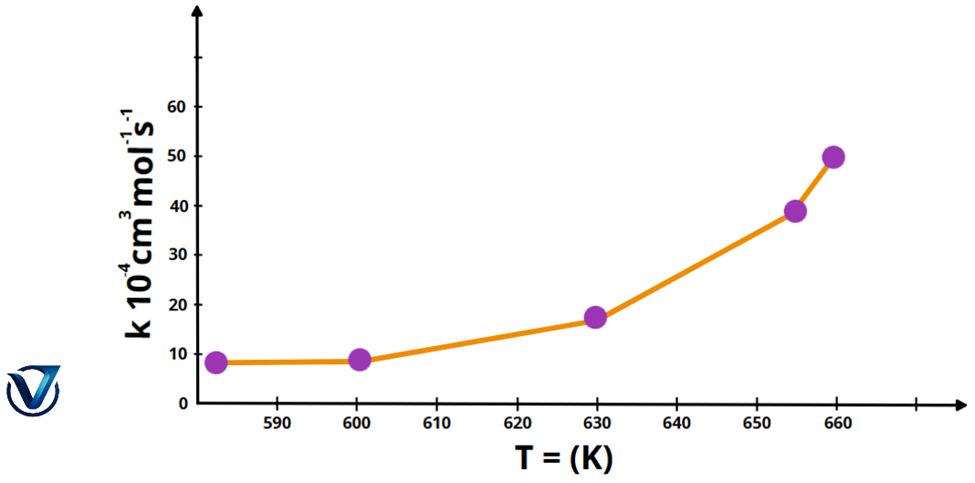
Why does temperature have such a strong effect?
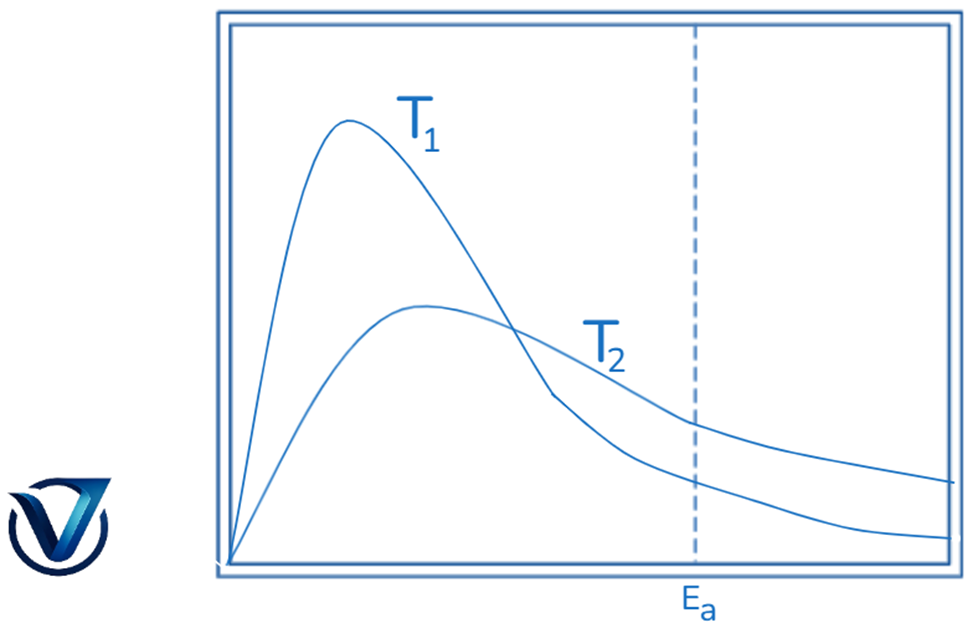
A temperature increase changes the distribution of molecular energies. Although the average kinetic energy rises, the most important change for many activated reactions is the increased fraction of molecules in the high-energy tail. Since the rate constant depends exponentially on \(1/T\), even a moderate temperature increase can produce a substantial change.
Temperature Coefficient of a Reaction
The temperature coefficient describes how much a reaction rate or rate constant changes when the temperature increases by a specified amount, commonly 10 °C. For the rate constant, it can be expressed as:
Many reactions show an approximate \(Q_{10}\) of 2 to 3 over a limited temperature range, but this is a rule of thumb rather than a universal law. The actual value depends on activation energy, the starting temperature, and whether the same reaction mechanism remains dominant.
The Arrhenius equation gives a more specific prediction for a chosen activation energy and pair of temperatures. Use the first calculator below to estimate the ratio of rate constants.
Arrhenius Plot: Determining Activation Energy
Taking the natural logarithm of the Arrhenius equation gives its linear form:
This has the form \(y=mx+c\). Plotting \(\ln k\) on the vertical axis against \(1/T\) on the horizontal axis gives a straight line when the reaction follows the Arrhenius model over the measured range.
- Slope: \(m=-E_a/R\)
- Vertical intercept: \(c=\ln A\)
- Activation energy: \(E_a=-mR\)
Because the horizontal axis is reciprocal temperature, its unit is \(\mathrm{K^{-1}}\). Use consistent units for the rate constant when taking logarithms; changing the units of \(k\) changes the numerical intercept, but not the slope when the same units are used for every measurement.
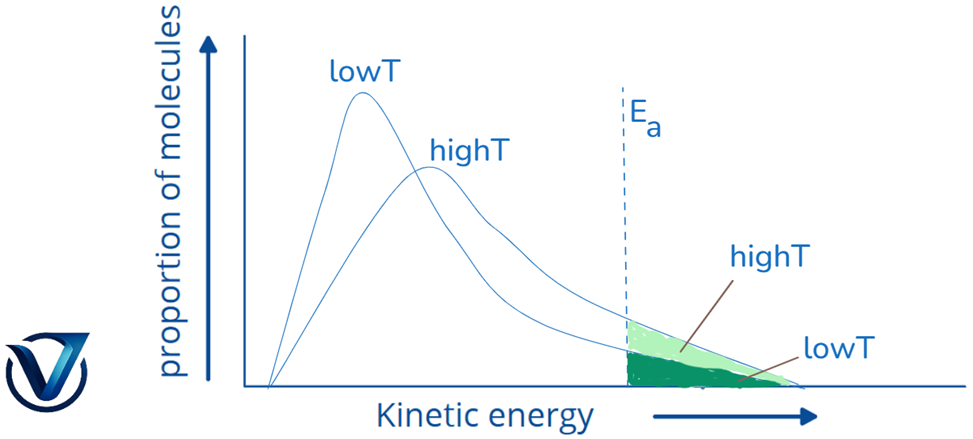
Effect of Temperature on Molecular Energy Distribution
Increasing temperature broadens and shifts the Maxwell–Boltzmann energy distribution. A greater fraction of molecules occupies the high-energy region, so a larger fraction may be able to cross the energy barrier. This helps explain why the rate constant can rise rapidly as temperature increases.
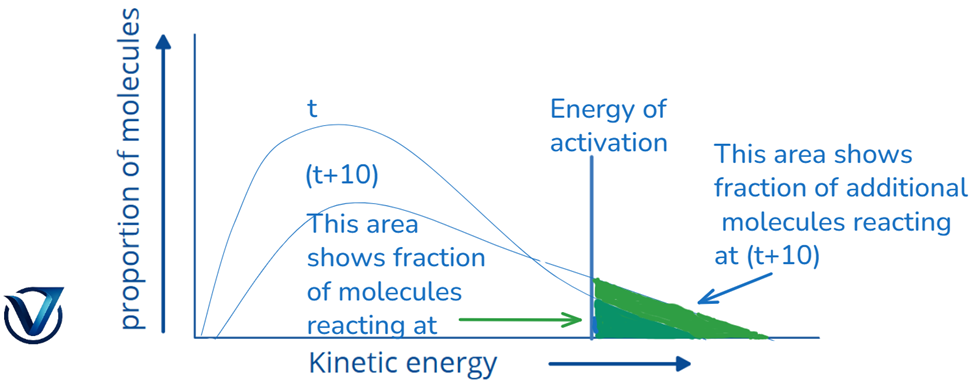
Two-Point Arrhenius Equation: Derivation
If rate constants are measured at two different temperatures, the activation energy can be estimated without knowing the pre-exponential factor \(A\), assuming the same Arrhenius model applies at both temperatures.
The common term \(\ln A\) cancels:
The equivalent base-10 logarithm form is:
How a Catalyst Affects Activation Energy
A catalyst provides an alternative reaction pathway with a different energy barrier. For a pathway with a lower activation energy and otherwise comparable conditions, the Arrhenius equation predicts a larger rate constant at the same temperature.
- A catalyst participates in the reaction mechanism and is regenerated overall.
- The amount of catalyst required depends on the reaction and operating conditions.
- A catalyst does not change the equilibrium constant for a given reaction at a fixed temperature.
- A catalyst can accelerate both forward and reverse reactions, helping the system reach equilibrium more quickly.
- The observed rate enhancement depends on the complete reaction mechanism; the pre-exponential factor may also differ between pathways.
Worked Example: Calculate the Rate-Constant Ratio
Suppose a reaction has an activation energy of \(50\ \mathrm{kJ/mol}\). Estimate how much its rate constant changes when the temperature rises from \(300\ \mathrm{K}\) to \(310\ \mathrm{K}\), assuming Arrhenius behaviour and a constant pre-exponential factor.
Given:
- \(E_a=50{,}000\ \mathrm{J/mol}\)
- \(T_1=300\ \mathrm{K}\)
- \(T_2=310\ \mathrm{K}\)
- \(R=8.314\ \mathrm{J\,mol^{-1}\,K^{-1}}\)
Substitute into the two-point equation:
This gives \(k_2/k_1\approx 1.91\). Under these assumptions, the rate constant is approximately 1.9 times its original value after a 10 K temperature increase.
This is an illustrative calculation, not a universal temperature rule. A reaction with a different activation energy or starting temperature can have a different ratio.
Interactive Arrhenius Equation Calculators
Enter values in the fields below. Use kelvin for temperatures and kJ/mol for the activation energy in Calculator 1. Calculator 2 requires positive rate constants measured at two different absolute temperatures.
Calculator 1: Calculate the rate-constant ratio \(k_2/k_1\)
Calculator 2: Estimate activation energy from two rate constants
Arrhenius Equation Video Lecture
Review the Arrhenius equation with the Urdu/Hindi lecture. An English lecture can be added when a suitable video is available.
Currently showing the Urdu/Hindi lecture.
Summary of Important Arrhenius Equations
| Purpose | Equation |
|---|---|
| Arrhenius equation | \(k=Ae^{-E_a/(RT)}\) |
| Linear Arrhenius form | \(\ln k=\ln A-E_a/(RT)\) |
| Two-temperature rate ratio | \(\ln(k_2/k_1)=(E_a/R)(1/T_1-1/T_2)\) |
| Activation energy from two rate constants | \(E_a=R\ln(k_2/k_1)/(1/T_1-1/T_2)\) |
| Temperature coefficient over 10 K | \(Q_{10}=k(T+10)/k(T)\) |
Frequently Asked Questions
1. What is the Arrhenius equation used for?
It is used to describe and estimate how a reaction’s rate constant changes with temperature. It is also used to estimate activation energy from rate measurements or an Arrhenius plot, provided the model is appropriate for the reaction and temperature range.
2. What does activation energy mean?
Activation energy is a measure of the energy barrier associated with a reaction pathway. A larger positive activation energy generally makes the rate constant more sensitive to temperature under the Arrhenius model.
3. Why must temperature be measured in kelvin?
The Arrhenius equation uses absolute temperature in its exponential term. Celsius temperatures cannot be substituted directly because the Celsius scale does not start at absolute zero.
4. What does the slope of an Arrhenius plot represent?
For a plot of \(\ln k\) against \(1/T\), the slope is \(-E_a/R\). Multiplying the negative slope by the gas constant gives the activation energy, with units kept consistent.
5. Does a catalyst change the equilibrium constant?
No. At a fixed temperature, a catalyst changes reaction kinetics rather than the thermodynamic equilibrium constant. It can speed up the forward and reverse reactions so equilibrium is reached sooner.
6. Does the rate constant always double when temperature rises by 10 °C?
No. A doubling is only a rough rule of thumb for some reactions and temperature ranges. The predicted change depends on activation energy, the starting temperature, and whether the Arrhenius approximation remains valid.
7. Can activation energy be negative?
Some complex reactions show an apparent negative activation energy over a limited temperature range, often because of multistep mechanisms or temperature-dependent pre-equilibria. This does not mean that every elementary reaction has a negative energy barrier. The simple interpretation of \(E_a\) as a positive barrier is most straightforward for ordinary Arrhenius behaviour.
Download Complete Notes Below
Proudly Powered By


Leave a Comment