
Calorimetry: Measuring Heat Transfer
Calorimetry is the branch of science dedicated to measuring the heat exchanged during physical or chemical processes. These changes may be physical (melting, evaporation, freezing) or chemical (combustion, neutralisation). A calorimeter is the device used to quantify temperature variations and thus determine heat flow. Calorimetry is essential in thermochemistry for calculating enthalpy, stability, specific heat capacity, and reaction energetics.
This statement is the fundamental principle of calorimetry — a direct consequence of the law of conservation of energy. The heat exchanged is calculated using the calorimetry equation:
where Q is heat energy (joules), m is mass (g), C is specific heat capacity (J/g·K), and ΔT is temperature change (K or °C).
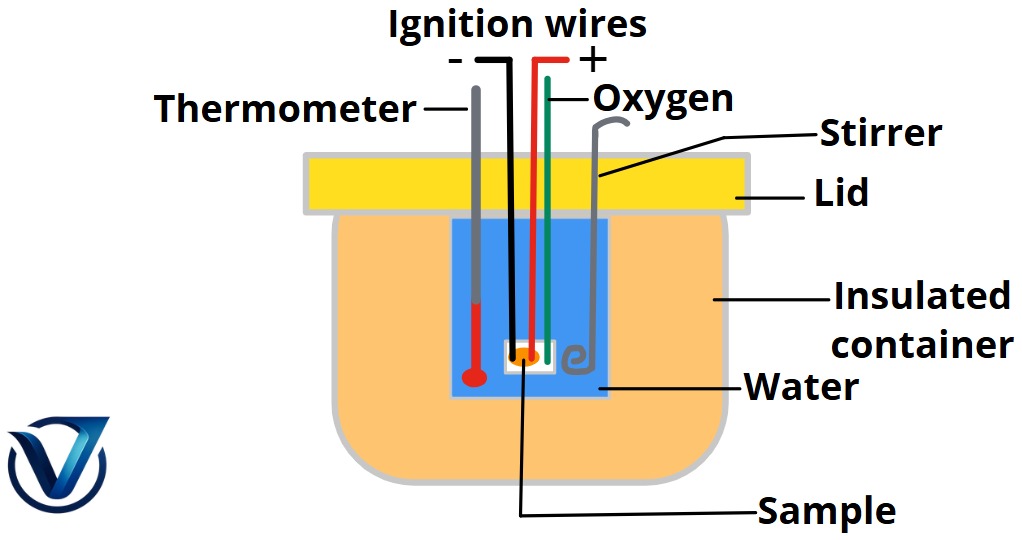
Bomb Calorimeter: Measuring Heat of Combustion
A bomb calorimeter is a constant‑volume calorimeter used to measure the heat of combustion of a substance. The sample is placed inside a heavy‑walled steel container (the “bomb”) with oxygen, and ignited electrically. The heat released raises the temperature of the surrounding water jacket. From the temperature rise and the known heat capacity of the calorimeter, the energy released per mole can be calculated.
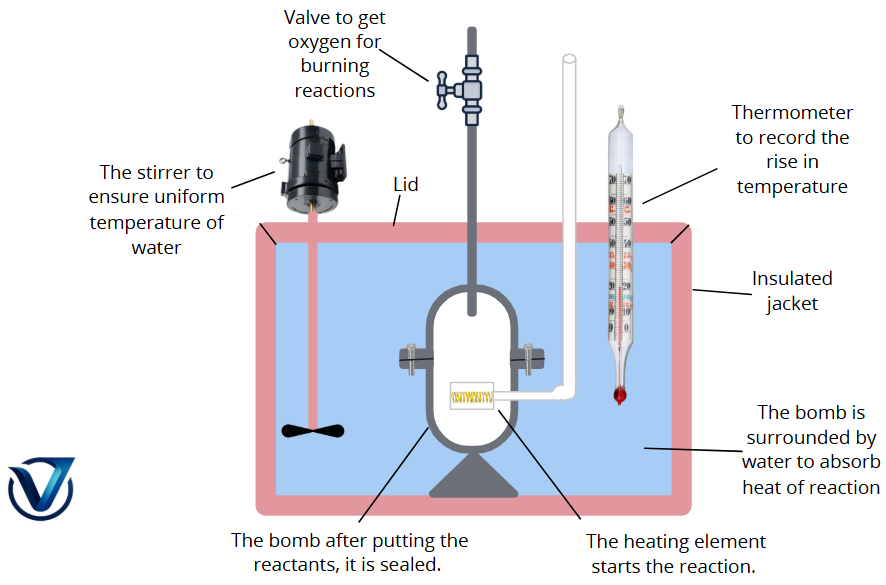
Applications of Bomb Calorimeter
- Thermodynamic Investigations: Measures heat of combustion, reaction enthalpy, and enthalpy changes — critical for theoretical chemistry.
- Educational Training: Used in university and advanced high school laboratory courses to demonstrate thermochemistry.
- Fuel Examination: Determines the calorific value of solid and liquid fuels (coal, oil, kerosene) — essential for quality control and trade.
- Waste and Refuse Management: Evaluates hazardous waste used as alternative fuel in cement industry, ensuring compliance with environmental regulations.
- Metabolic Investigations: Calculates the caloric content of food products, helping to study dietary effects on human and animal health.
- Testing of Propellants and Explosives: Measures the heat of detonation for safety and performance evaluation.
🧪 Interactive Simulation: Heat Lost = Heat Gained
Mix a hot object (e.g., a metal) with cold water in a calorimeter. Find the final equilibrium temperature using the principle of calorimetry.
💡 Heat lost by hot object = Heat gained by water. Assumes perfect insulation (no heat loss to surroundings).
📏 Direct Calculator: Heat Energy (Q = m·C·ΔT)
Important Values for Calorimetry
| Substance | Specific heat capacity (J/g·K) |
|---|---|
| Water (liquid) | 4.184 |
| Aluminium | 0.897 |
| Copper | 0.385 |
| Iron | 0.450 |
| Ethanol | 2.440 |
📝 Calorimetry & Thermochemistry Quiz
1. A bomb calorimeter is primarily used to measure:
2. Thermochemistry deals with:
3. In an exothermic reaction:
4. The principle of calorimetry states that:
5. Which of the following is a direct application of bomb calorimetry?
Download Complete Notes Below
Proudly Powered By


Leave a Comment