
Thermochemistry
Heat, Enthalpy & Energy
Understanding energy changes in chemical reactions — endothermic vs exothermic, enthalpy, and the first law of thermodynamics.
What is Thermochemistry?
Thermochemistry is the branch of physical chemistry that studies the heat and energy associated with chemical reactions and physical transformations. Energy may be absorbed (endothermic) or released (exothermic) during a reaction. Thermochemistry focuses on energy changes, particularly the energy exchange between a system and its surroundings.
The first law of thermodynamics (conservation of energy) states that energy cannot be created or destroyed — only transferred. For a chemical reaction, the change in internal energy (ΔU) equals heat (q) plus work (w): ΔU = q + w. At constant pressure (common in open vessels), the heat flow equals the enthalpy change (ΔH): ΔH = q_p.
Enthalpy (H) is a state function that reflects the total heat content of a system. The enthalpy change of a reaction is the difference between the enthalpy of products and reactants: ΔHrxn = ΣHproducts − ΣHreactants. Exothermic reactions release heat (ΔH < 0), while endothermic reactions absorb heat (ΔH > 0).
Absorbs heat from the surroundings. The system gains energy, and the surroundings cool down. Example: melting of ice, thermal decomposition of calcium carbonate.
Releases heat to the surroundings. The system loses energy, and the surroundings warm up. Example: combustion of methane, neutralisation of acids and bases.
A state function that includes internal energy plus the product of pressure and volume. At constant pressure, the heat change equals the enthalpy change.
Calorimetry: Measuring Heat Transfer
Calorimetry is the experimental technique used to measure heat changes in chemical and physical processes. A simple calorimeter (coffee‑cup calorimeter) is used for reactions at constant pressure, allowing direct measurement of enthalpy change (ΔH = qp). The heat absorbed or released is calculated using the specific heat capacity equation: q = m·c·ΔT.
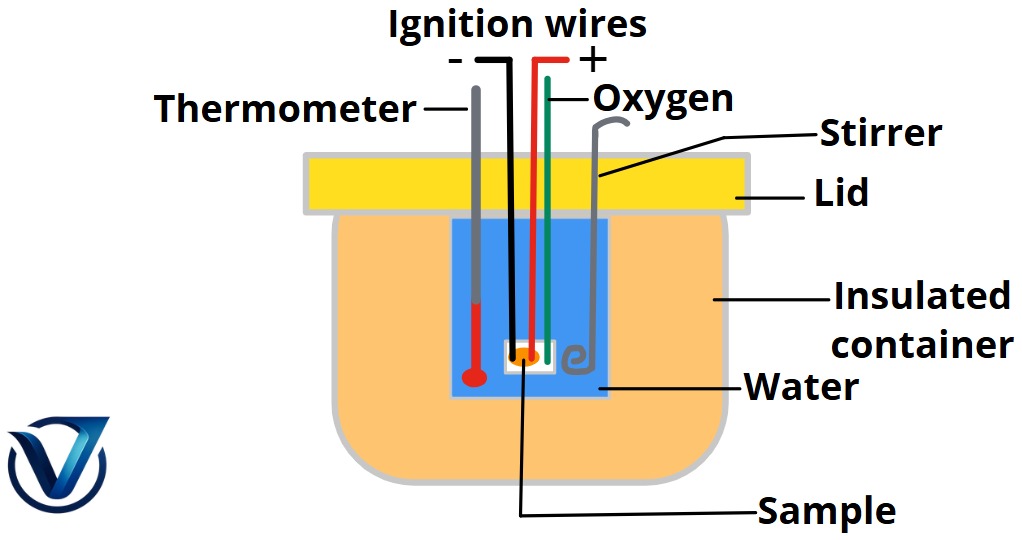
In a calorimeter, the heat released by an exothermic reaction is absorbed by the surrounding water (or the calorimeter itself). Using the known specific heat capacity of water (4.184 J/g·K) and the observed temperature change, the enthalpy change can be accurately determined. This principle is fundamental to food calorimetry, bomb calorimetry for combustion reactions, and many industrial applications.
Endothermic vs Exothermic Simulation
Adjust the reaction type and see how temperature changes. The bar below shows the heat flow direction.
In an endothermic reaction, the surroundings cool down (ΔT negative).
Standard Enthalpies of Formation (ΔHf° at 298 K)
The standard enthalpy of formation is the heat change when one mole of a compound is formed from its elements in their standard states. These values are used to calculate reaction enthalpies.
| Compound | Formula | ΔHf° (kJ/mol) | |||||||||||||||||||
|---|---|---|---|---|---|---|---|---|---|---|---|---|---|---|---|---|---|---|---|---|---|
| Water (liquid)
💡 In an exothermic reaction, the surroundings heat up (ΔT positive). In an endothermic reaction, the surroundings cool down (ΔT negative). 04 — Reference Data Standard Enthalpies of Formation (ΔHf° at 298 K)The standard enthalpy of formation is the heat change when one mole of a compound is formed from its elements in their standard states. These values are used to calculate reaction enthalpies.
05 — Mathematical Framework Core Equations of ThermochemistryFirst Law of ThermodynamicsΔU = q + w At constant pressure (open vessel): ΔH = qp = ΔU + PΔV Enthalpy of reaction: ΔH°rxn = Σ ν ΔHf°(products) − Σ ν ΔHf°(reactants) Hess’s Law: Enthalpy change is independent of path; total ΔH = sum of steps. Calorimetry: q = m · c · ΔT (m = mass, c = specific heat capacity, ΔT = temperature change)
Bond Enthalpy approximation: ΔHrxn = Σ (bonds broken) − Σ (bonds formed) 06 — Test Your Understanding Advanced MCQ Test 💪Self-Assessment Quiz6 QuestionsQ 01 / 06 Which statement correctly describes an endothermic chemical reaction? Q 02 / 06 Hess’s Law is based on which principle? Q 03 / 06 For an exothermic reaction, which of the following is true? Q 04 / 06 The standard enthalpy of formation (ΔH_f°) of a compound is defined as: Q 05 / 06 Which equation correctly relates heat (q), mass (m), specific heat capacity (c), and temperature change (ΔT) in calorimetry? Q 06 / 06 The first law of thermodynamics can be written as: 07 — Video Lectures Watch the Full Lecture🎬 Interactive Video Lecture Series |
Download Complete Notes Below
Proudly Powered By


Leave a Comment