Electrophoresis | Principles, Types & Simulation Electrophoresis: Separation of Charged Molecules Principles · Gel Electrophoresis · Capillary Electrophoresis · Continuous Particle Simulation
🧪 Real-time Electrophoresis Simulation Charged particles move in an electric field. Negative → anode (+), Positive → cathode (−). Smaller particles move faster.
+ −
Drag particles to mix · Double-click canvas to reset
Molecules migrate according to charge and size.
Electrophoresis is a technique used to separate charged particles (such as DNA, RNA, proteins) based on their size and charge by applying an electric field. Molecules migrate through a gel or liquid medium at different speeds: smaller/faster or more highly charged molecules move farther. It is essential in molecular biology, forensic science, clinical diagnostics, and biochemistry.
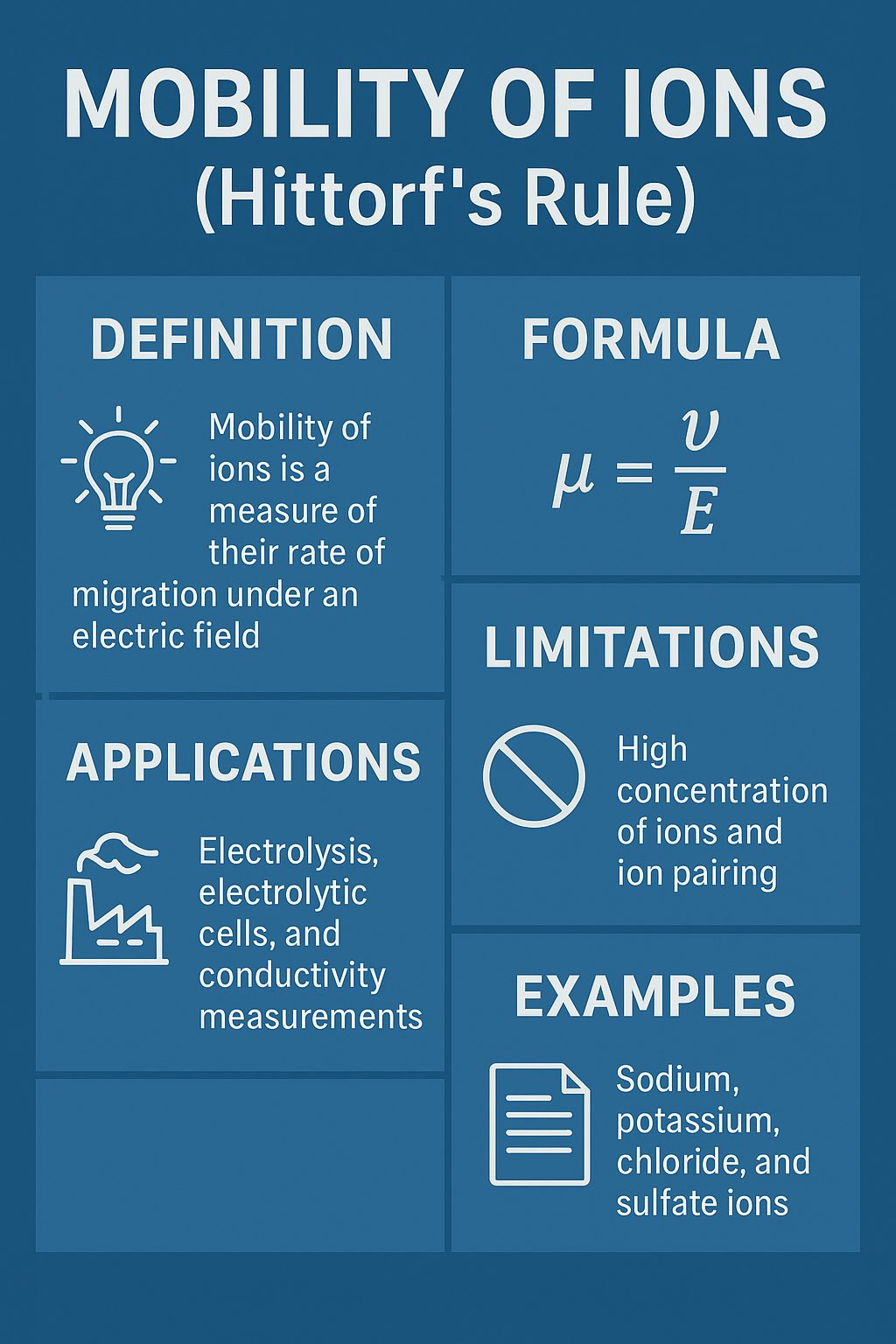
🧬 Migration velocity (v) = μ × E where μ = electrophoretic mobility, E = electric field strength
Principle of Electrophoresis Charged molecules placed in an electric field experience a force proportional to their net charge. They migrate toward the oppositely charged electrode. The matrix (gel, capillary) provides resistance that separates molecules by size: smaller molecules move faster through the pores. The electrophoretic mobility (μ) depends on charge, size, shape, and medium viscosity.
Types of Electrophoresis 🧬 Gel Electrophoresis (Agarose/PAGE) Separates DNA fragments, RNA, or proteins by size using an agarose or polyacrylamide gel. Visualised with stains (EtBr, Coomassie).
🧪 Capillary Electrophoresis (CE) High-resolution separation in narrow capillaries. Fast, automated, used in DNA sequencing and pharmaceutical analysis.
⚡ SDS-PAGE (Proteins) SDS denatures proteins and imparts uniform negative charge; separation by molecular weight only.
🧬 Pulsed‑Field Gel Electrophoresis (PFGE) Alternating electric fields separate very large DNA molecules (e.g., whole chromosomes).
🧫 Isoelectric Focusing (IEF) Separates proteins by their isoelectric point (pI) using a pH gradient.
🔬 Zonal Electrophoresis Uses a density gradient to stabilise separated zones; used in clinical labs.
Applications of Electrophoresis DNA fingerprinting / forensics: Matching crime scene samples.Diagnostics: Detection of genetic mutations, sickle cell anaemia, HIV.Protein analysis: Purity check, molecular weight determination.Pharmaceutical QC: Purity of biopharmaceuticals (insulin, antibodies).Environmental microbiology: Identification of microbial communities.Factors Affecting Electrophoretic Mobility Net charge: Higher charge → greater mobility.Size & shape: Smaller, globular proteins move faster.Electric field strength: Higher voltage → faster migration.Buffer pH: Determines ionisation state of molecules.Gel concentration: Higher agarose % slows larger DNA fragments.🎥 Complete Lecture: Electrophoresis (Urdu/Hindi)
© 2025 — Complete guide to Electrophoresis. Theory, types, continuous particle simulation, MCQ quiz, and video lecture.
(function() {
var canvas = document.getElementById(‘electroCanvas’);
var ctx = canvas.getContext(‘2d’);
var sampleSelect = document.getElementById(‘sampleSelect’);
var voltageSlider = document.getElementById(‘voltageSlider’);
var voltageValue = document.getElementById(‘voltageValue’);
var speedSlider = document.getElementById(‘speedSlider’);
var resultBox = document.getElementById(‘electroResult’);
var resetBtn = document.getElementById(‘resetElectroBtn’);
var pauseBtn = document.getElementById(‘pauseElectroBtn’);
var playBtn = document.getElementById(‘playElectroBtn’);var W = 780, H = 360;
var TOP = 42, BOTTOM = 310;
var LEFT = 48, RIGHT = 732;
var CX = LEFT + 18;
var AX = RIGHT – 18;var molecules = [];
var voltage = 90;
var speedMul = 1.0;
var running = true;
var last = performance.now();
var simTime = 0;function createMolecules(type) {
molecules = [];
var N = 42;
var charges = [];
var i, j, temp;if (type === ‘dna’) {
for (i = 0; i < Math.floor(N * 0.85); i++) charges.push(-1);
while (charges.length < N) charges.push(0);
} else if (type === 'proteins') {
for (i = 0; i < Math.floor(N * 0.35); i++) charges.push(-1);
for (i = 0; i < Math.floor(N * 0.35); i++) charges.push(1);
while (charges.length < N) charges.push(0);
} else if (type === 'dyes') {
for (i = 0; i < Math.floor(N * 0.45); i++) charges.push(-1);
for (i = 0; i < Math.floor(N * 0.35); i++) charges.push(1);
while (charges.length < N) charges.push(0);
} else {
for (i = 0; i < Math.floor(N * 0.4); i++) charges.push(-1);
for (i = 0; i < Math.floor(N * 0.4); i++) charges.push(1);
while (charges.length 0; i–) {
j = Math.floor(Math.random() * (i + 1));
temp = charges[i];
charges[i] = charges[j];
charges[j] = temp;
}for (i = 0; i < N; i++) {
var size = 3.0 + Math.random() * 7.2;
var mobility = 1.2 / (size * 0.28 + 0.65);
molecules.push({
x: LEFT + 42 + Math.random() * (RIGHT – LEFT – 84),
y: TOP + 18 + Math.random() * (BOTTOM – TOP – 36),
charge: charges[i],
size: size,
mobility: mobility
});
}
simTime = 0;
updateResult();
}function update(dt) {
if (!running) return;
var E = voltage / 100;
var thermal = 0.08;
var m, dir, v;
for (var k = 0; k < molecules.length; k++) {
m = molecules[k];
dir = 0;
if (m.charge === -1) dir = 1;
else if (m.charge === 1) dir = -1;
v = dir * m.mobility * E * 52 * speedMul * dt;
m.x += v + (Math.random() – 0.5) * thermal;
m.y += (Math.random() – 0.5) * thermal * 0.48;
if (m.x RIGHT – 11) m.x = RIGHT – 11;
if (m.y BOTTOM – 11) m.y = BOTTOM – 11;
}
simTime += dt;
updateResult();
}function updateResult() {
var neg = 0, pos = 0, neu = 0;
for (var k = 0; k < molecules.length; k++) {
if (molecules[k].charge === -1) neg++;
else if (molecules[k].charge === 1) pos++;
else neu++;
}
resultBox.innerHTML = 'Time: ' + simTime.toFixed(1) + ' s | − ' + neg + ' + ' + pos + ' ∘ ' + neu + ' | Field: ' + voltage + ' V';
}function draw() {
ctx.clearRect(0, 0, W, H);
ctx.fillStyle = '#0c1a28';
ctx.fillRect(0, 0, W, H);ctx.fillStyle = 'rgba(20, 50, 80, 0.35)';
ctx.beginPath();
if (ctx.roundRect) {
ctx.roundRect(LEFT, TOP, RIGHT – LEFT, BOTTOM – TOP, 10);
} else {
ctx.rect(LEFT, TOP, RIGHT – LEFT, BOTTOM – TOP);
}
ctx.fill();ctx.strokeStyle = 'rgba(90, 160, 220, 0.07)';
ctx.lineWidth = 1;
for (var y = TOP + 22; y ‘, LEFT + 60, BOTTOM – 8);
ctx.fillText(‘<-', RIGHT – 60, BOTTOM – 8);for (var k = 0; k < molecules.length; k++) {
var m = molecules[k];
var r = m.size * 0.5 + 2.0;
var col, mark;
if (m.charge === -1) { col = '#ff6b6b'; mark = '-'; }
else if (m.charge === 1) { col = '#4d8eff'; mark = '+'; }
else { col = '#a8d06a'; mark = 'o'; }ctx.shadowColor = col + '70';
ctx.shadowBlur = 13;
ctx.beginPath();
ctx.arc(m.x, m.y, r, 0, Math.PI * 2);
ctx.fillStyle = col;
ctx.fill();ctx.shadowBlur = 0;
ctx.beginPath();
ctx.arc(m.x – r * 0.25, m.y – r * 0.3, r * 0.28, 0, Math.PI * 2);
ctx.fillStyle = 'rgba(255,255,255,0.2)';
ctx.fill();ctx.fillStyle = 'rgba(255,255,255,0.78)';
var fs = Math.max(8, r * 0.7);
ctx.font = 'bold ' + fs + 'px sans-serif';
ctx.textAlign = 'center';
ctx.textBaseline = 'middle';
ctx.fillText(mark, m.x, m.y + 0.5);
}
}function loop(now) {
var dt = Math.min((now – last) / 1000, 0.05);
last = now;
update(dt);
draw();
requestAnimationFrame(loop);
}voltageSlider.addEventListener('input', function() {
voltage = +voltageSlider.value;
voltageValue.textContent = voltage + ' V';
});
speedSlider.addEventListener('input', function() {
speedMul = +speedSlider.value;
});
sampleSelect.addEventListener('change', function() {
createMolecules(sampleSelect.value);
});
resetBtn.addEventListener('click', function() {
createMolecules(sampleSelect.value);
});
pauseBtn.addEventListener('click', function() {
running = false;
});
playBtn.addEventListener('click', function() {
running = true;
last = performance.now();
});
canvas.addEventListener('dblclick', function() {
createMolecules(sampleSelect.value);
});var drag = false;
canvas.addEventListener('mousedown', function() { drag = true; });
window.addEventListener('mouseup', function() { drag = false; });
canvas.addEventListener('mousemove', function(e) {
if (!drag) return;
var rect = canvas.getBoundingClientRect();
var sx = canvas.width / rect.width;
var mx = (e.clientX – rect.left) * sx;
var my = (e.clientY – rect.top) * sx;
for (var k = 0; k < molecules.length; k++) {
var m = molecules[k];
var dx = m.x – mx;
var dy = m.y – my;
var d = Math.sqrt(dx * dx + dy * dy);
if (d 1) {
var f = 2.9 / (d + 1);
m.x += (dx / d) * f;
m.y += (dy / d) * f;
}
}
}
});
canvas.addEventListener(‘touchmove’, function(e) {
e.preventDefault();
var t = e.touches[0];
var rect = canvas.getBoundingClientRect();
var sx = canvas.width / rect.width;
var mx = (t.clientX – rect.left) * sx;
var my = (t.clientY – rect.top) * sx;
for (var k = 0; k < molecules.length; k++) {
var m = molecules[k];
var dx = m.x – mx;
var dy = m.y – my;
var d = Math.sqrt(dx * dx + dy * dy);
if (d 1) {
var f = 2.9 / (d + 1);
m.x += (dx / d) * f;
m.y += (dy / d) * f;
}
}
}
}, { passive: false });createMolecules(‘mixed’);
requestAnimationFrame(loop);var submitQuiz = document.getElementById(‘submitQuizBtn’);
var quizResultDiv = document.getElementById(‘quizResult’);
var questions = document.querySelectorAll(‘.question’);submitQuiz.addEventListener(‘click’, function() {
var score = 0;
var total = questions.length;
for (var idx = 0; idx < questions.length; idx++) {
var q = questions[idx];
var correctVal = q.getAttribute('data-correct');
var selected = q.querySelector('input[type=radio]:checked');
var labels = q.querySelectorAll('.options label');
var expDiv = q.querySelector('.explanation');
for (var li = 0; li < labels.length; li++) {
labels[li].classList.remove('correct');
labels[li].classList.remove('wrong');
}
if (selected) {
if (selected.value === correctVal) {
score++;
selected.parentElement.classList.add('correct');
} else {
selected.parentElement.classList.add('wrong');
}
}
for (var li = 0; li = 80) msg += “Excellent! You’ve mastered electrophoresis.”;
else if (percent >= 60) msg += ‘Good! Review the types and applications.’;
else msg += ‘Please re-read the theory and try the simulation.’;
quizResultDiv.innerHTML = msg;
quizResultDiv.style.padding = ’12px’;
quizResultDiv.style.background = ‘#e6f0f5′;
quizResultDiv.style.borderRadius = ’20px’;
submitQuiz.textContent = ‘Retake Quiz’;
submitQuiz.onclick = function() { location.reload(); };
});
})();
Download Complete Notes Below Proudly Powered By



Leave a Comment