Redox Reactions
Electron transfer, oxidation states, and the chemistry that powers batteries, metabolism, and industry
📺 Video Lectures
Detailed explanations of oxidation, reduction, half-reactions, and types of redox reactions.
1. Oxidation Reaction
Oxidation can be defined in two complementary ways:
- Electron loss: Loss of electrons by a substance (increase in oxidation state).
- Classical definition: Addition of oxygen or a more electronegative element, or removal of hydrogen or a more electropositive element.
2S(s) + O₂(g) → SO₂(g)
CH₄(g) + 2O₂(g) → CO₂(g) + 2H₂O(l)
In the second reaction, carbon is oxidized from −4 to +4, while oxygen is reduced from 0 to −2.
2. Reduction Reaction
Reduction is the opposite of oxidation:
- Electron gain: Gain of electrons by a substance (decrease in oxidation state).
- Classical definition: Addition of hydrogen or a more electropositive element, or removal of oxygen or a more electronegative element.
2CH₂=CH₂(g) + H₂(g) → CH₃–CH₃(g) (hydrogenation)
2FeCl₃(aq) + H₂(g) → 2FeCl₂(aq) + 2HCl(aq) (iron reduced from +3 to +2)
3. Redox Reactions: Electron Transfer
A redox reaction is a chemical reaction in which electrons are transferred between two species. The species that loses electrons is oxidized; the species that gains electrons is reduced. These two processes always occur together.
Electron transfer between A (reducing agent) and B (oxidizing agent).
A → A⁺ + e⁻ (oxidation); B + e⁻ → B⁻ (reduction).
Accepts electrons; undergoes reduction.
Example: KMnO₄, O₂, F₂.
Donates electrons; undergoes oxidation.
Example: Zn, NaBH₄, H₂.
4. Types of Redox Reactions
Compound breaks down into simpler substances.
Examples: 2NaH → 2Na + H₂; 2H₂O → 2H₂ + O₂.
General form: AB → A + B.
Two or more substances combine to form a single product.
Examples: H₂ + Cl₂ → 2HCl; C + O₂ → CO₂.
General form: A + B → AB.
One element displaces another from its compound.
General: X + YZ → XZ + Y.
Metal displacement: CuSO₄ + Zn → Cu + ZnSO₄.
Non‑metal displacement: 2NaBr + Cl₂ → 2NaCl + Br₂.
A single substance is simultaneously oxidized and reduced.
Example: P₄ + 3NaOH + 3H₂O → 3NaH₂PO₂ + PH₃.
Chlorine in water: Cl₂ + H₂O → HCl + HOCl (Cl from 0 to –1 and +1).
5. Worked Examples of Redox Reactions
Example 1: Hydrogen + Fluorine
Oxidation half: H₂ → 2H⁺ + 2e⁻ (H from 0 to +1)
Reduction half: F₂ + 2e⁻ → 2F⁻ (F from 0 to –1)
Overall: H₂ + F₂ → 2H⁺ + 2F⁻ → 2HF
Example 2: Zinc + Copper(II) Sulfate (Metal displacement)
Oxidation: Zn → Zn²⁺ + 2e⁻ (Zn is reducing agent, oxidized)
Reduction: Cu²⁺ + 2e⁻ → Cu (Cu²⁺ is oxidizing agent, reduced)
Net ionic: Zn + Cu²⁺ → Zn²⁺ + Cu
6. Balancing Redox Equations
In acidic or basic media, half‑reaction method is used:
- Write separate half‑reactions (oxidation and reduction).
- Balance atoms other than H and O.
- Balance O by adding H₂O, balance H by adding H⁺ (acidic) or OH⁻ (basic).
- Balance charge by adding electrons.
- Multiply half‑reactions so that electrons cancel, then add them.
Balanced: MnO₄⁻ + 5Fe²⁺ + 8H⁺ → Mn²⁺ + 5Fe³⁺ + 4H₂O
7. Applications & Importance of Redox Reactions
Galvanic cells convert chemical energy to electrical energy via spontaneous redox reactions (e.g., Zn–Cu cell).
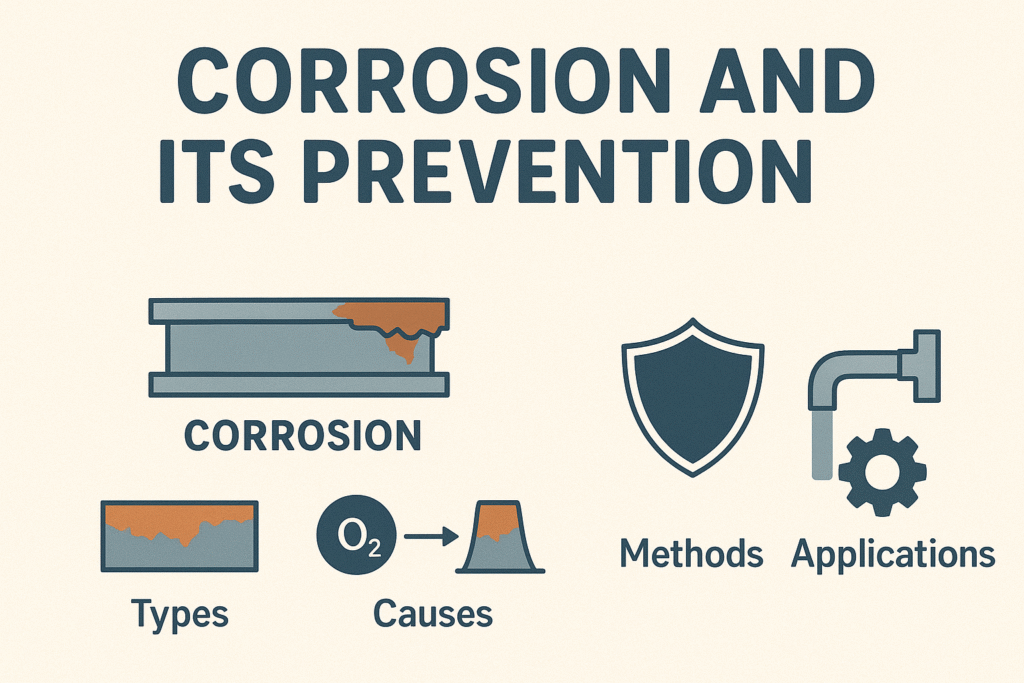
Iron oxidizes in presence of oxygen and water, forming rust (Fe₂O₃·xH₂O).
Extraction of metals from ores: reduction of metal oxides with carbon or other metals.
All combustion reactions are redox: fuel + O₂ → CO₂ + H₂O.
Photosynthesis: CO₂ + H₂O → glucose + O₂ (water oxidized, CO₂ reduced).
Respiration: glucose + O₂ → CO₂ + H₂O + energy.
Redox titrations (e.g., permanganometry, iodometry) determine concentrations of oxidizing or reducing agents.
Bleaching, water disinfection (chlorine), electroplating, production of hydrogen and chlorine via electrolysis.
Removal of pollutants by redox reactions (e.g., chromium(VI) reduction to Cr(III)).
The concept of redox reactions is fundamental to understanding energy production, material degradation, and countless chemical transformations in nature and technology.
8. Quick Reference: Key Terms
| Term | Definition |
|---|---|
| Oxidation | Loss of electrons, increase in oxidation state; addition of oxygen or removal of hydrogen. |
| Reduction | Gain of electrons, decrease in oxidation state; addition of hydrogen or removal of oxygen. |
| Oxidizing agent | Accepts electrons, gets reduced. |
| Reducing agent | Donates electrons, gets oxidized. |
| Half‑reaction | One of two parts of a redox reaction, showing either oxidation or reduction separately. |
| Disproportionation | A single element is simultaneously oxidized and reduced. |
9. Summary
- Redox reactions involve the transfer of electrons between species.
- Oxidation = loss of electrons; reduction = gain of electrons (OIL RIG).
- Types: decomposition, combination, displacement, disproportionation.
- Half‑reactions help in balancing and understanding electron flow.
- Redox chemistry is central to batteries, corrosion, metabolism, combustion, and many industrial processes.
Download Complete Notes Below
Proudly Powered By